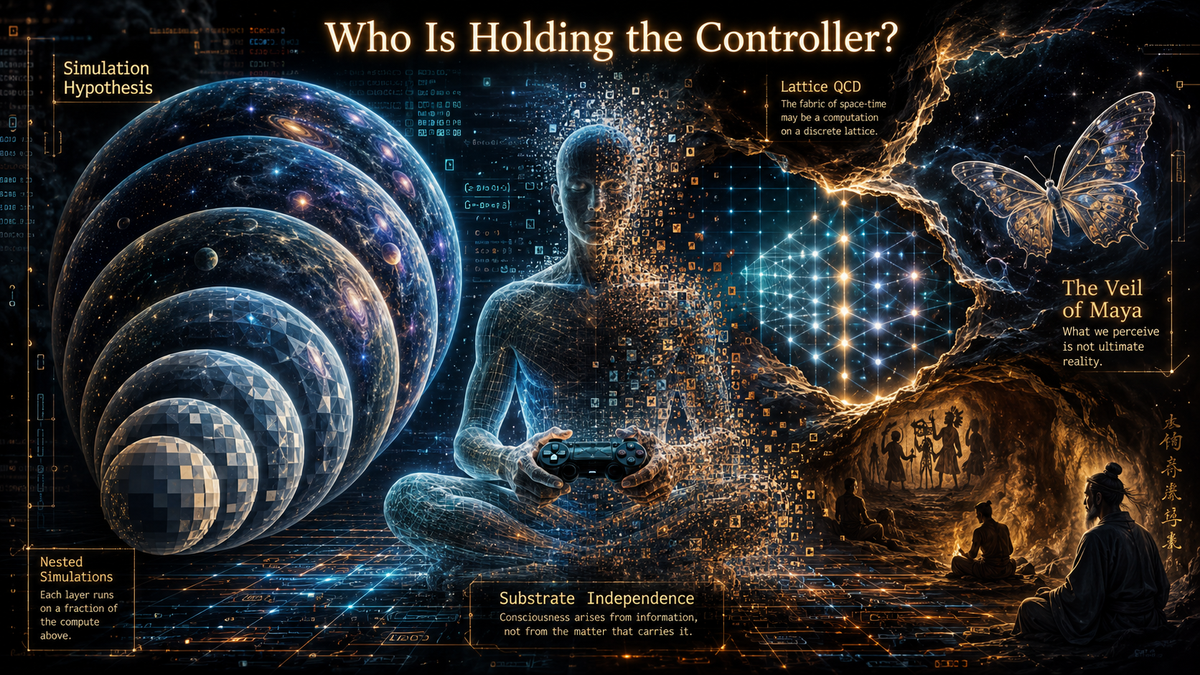
Who Is Holding the Controller? From Simulation Hypothesis to 'Maya'

Gastón Rey
Do we live in a simulated reality? The question sounds like a discarded sci-fi premise, yet it is taken seriously by physicists, philosophers, and tech-prophets alike. Oxford philosopher Nick Bostrom gave it a rigorous mathematical spine in 2003, but the underlying notion is far older. For Hinduism it is an ancient spiritual claim: "Maya" (माया), the veil of illusion that keeps us from seeing reality as it truly is. Lay the silicon logic of the simulation argument beside the metaphysics of Maya and something striking happens. Two traditions separated by millennia and methodology arrive at the same unsettling conclusion: the world you experience is not the bottom layer of what is real. What follows is an attempt to take both seriously, including where the analogy breaks down.
The 1% Rule: From Pong to Building Universes
To see how plausible a “matrix” is, we do not need to gaze into the deep future. We just need to look at our own recent past. Consider a video game from the 1970s, Pong: two rectangles and a dot. Now imagine a civilization that improves the realism of its simulations by just 1% a year. Compounding is merciless. A 1% annual gain doubles in roughly 70 years and grows a thousandfold in a few centuries. On that curve, pixelated dots become photorealistic, fully immersive worlds in a historically trivial span of time.
Pong (1972) → +1% realism per year → a world indistinguishable from reality
Layer in our current trajectory, a species learning to do in vitro fertilization, gene editing, cloning, and to build artificial intelligence that reasons on its own, and it becomes easy to imagine a civilization that, having dodged extinction, eventually commands enough computing power to render an entire planet, and then a universe, indistinguishable from the “real” one. A caveat worth stating plainly: realism may not climb in a straight line, and consciousness in particular may demand a qualitative leap rather than a thousand incremental gains. The 1% figure is not a forecast; it is an intuition pump. Its only purpose is to show how modest, compounding improvement can deliver outcomes that would have seemed historically unimaginable to anyone standing at the start of the curve. It all depends on the technology and the potential problems that each new advance may bring. Any judgment about nested simulations must remain probabilistic, reasoned by inference from observable constraints.
Where the argument actually gets hard Here is the step the slick version usually skips, and it is worth being clear about it: rendering is not the difficult part. Minds are. A photorealistic world with no one home inside it is just an expensive screensaver. The simulation argument only bites if the beings inside are genuinely conscious. That requires one large philosophical bet, substrate independence: the idea that consciousness arises from how information is organized, not from the specific stuff (neurons, carbon) doing the organizing. If minds can run on silicon as readily as on biology, the simulation hypothesis follows naturally. If they cannot, if there is something about wet biological brains that no computation can reproduce, the whole edifice loses its foundation. The argument is exactly as strong as that single assumption, no stronger.
The Inception Loop, and Why It Probably Cannot Go Forever
Now the mind-bending part: a simulated universe could do the same thing. Once conscious beings inside the simulation invent their own AI and ride their own 1% curve, they build their own simulations. Reality could become a cosmic Russian doll, simulations within simulations. But, and the original telling of this story rarely admits it, that nesting almost certainly cannot descend to infinity. In our own experience, every increase in computational power encounters bottlenecks: energy requirements, heat dissipation, information-processing limits, and finite material resources. It is therefore reasonable, absent evidence to the contrary, to project that future advances may push these constraints back but not abolish finitude itself. Every child simulation has to run on a slice of its parent’s finite computing budget, which is itself a slice of its grandparent’s. Each layer is strictly poorer in resources than the one above. Somewhere down the chain the available compute runs out, the worlds get coarser and cheaper, and the regress terminates. If resources diminish across successive layers, then beyond some point the available compute would no longer sustain worlds of comparable fidelity or conscious complexity. So the romantic image of infinite nested realities is, paradoxically, the part of the story that physics is least willing to grant. The doll has a smallest doll. This matters for the argument rather than against it: even a finite stack of simulated worlds can contain vastly more conscious beings than the single base reality at the top, which is all the next section needs.


Nick Bostrom’s Trilemma, Stated Carefully
In 2003 Bostrom turned this trajectory into a tight logical argument. His claim is more careful than the popular paraphrase, and the precision is what makes it hard to dismiss. He argues that at least one of the following three propositions must be true:
Extinction. Civilizations almost always die out before reaching the technological maturity required to run ancestor simulations. Disinterest. Mature civilizations reach that capability, but almost none of them actually choose to run such simulations. Simulation. We are almost certainly living in a computer simulation.
The trap is the disjunction itself. If the first two are false, if some civilizations survive and some of them do run ancestor simulations, then simulated minds would outnumber original biological ones by an astronomical margin. In that scenario, a randomly chosen conscious observer (you) is overwhelmingly likely to be one of the simulated many rather than one of the original few. Notice what Bostrom does not claim. He does not assert outright that we are simulated. He asserts that we cannot consistently hold all three of the following beliefs at once: that we will reach technological maturity, that we would run such simulations, and that we are not ourselves simulated. Pick any two and the third has to give. The popular line, “statistically, you are almost certainly in a simulation,” is only the conclusion of the third branch, not of the trilemma as a whole. Honor that distinction and the argument becomes much harder to wave away. Crucially, Bostrom's argument does not require infinity. It requires only that simulated observers vastly outnumber original ones. The image of endlessly nested realities may therefore be dispensable. A hierarchy that is finite, and even shallow, would be enough, so long as it is prolific: what carries the statistical force of the argument is the sheer number of simulated observers, not the number of layers.
Can We Actually Test This?
Here philosophy collides with physics, and with a serious objection: a perfect simulation would be, by definition, indistinguishable from reality, and an untestable claim is not science at all (this is Karl Popper’s falsifiability criterion). The interesting work of the last decade has been the search for cracks where an imperfect simulation might leak.
The lattice signature.
In 2012, physicists Silas Beane, Zohreh Davoudi, and Martin Savage noted that when we simulate the strong nuclear force (lattice QCD), we are forced to lay physics down on a discrete grid. If our own universe were such a simulation, that underlying grid might betray itself, most plausibly in the highest-energy cosmic rays, whose distribution could show a faint preferred direction reflecting the lattice’s geometry. They even estimated how fine such a grid would have to be. It is, remarkably, a real proposed experiment for a metaphysical question.
The information angle.
More recently, physicist Melvin Vopson has proposed a “second law of infodynamics,” arguing that information may behave like a physical, even compressible, quantity, and that the universe’s tendency toward symmetry and order resembles the data compression a resource-bound simulator would use. A strong caveat belongs here: most physicists remain unconvinced, and the proposal has not gained broad acceptance. It is best read as a speculative frontier claim that happens to be framed as testable (for instance, by searching for a predicted information-bearing particle), not as established science.
The cost objection.
Cutting the other way, several physicists argue from energy and information limits that faithfully simulating a universe at our observed fidelity would demand resources so colossal that it is nearly impossible we live in one. Compression and corner-cutting are the simulator’s only escape, which loops us right back to looking for the seams. The real status: no crack has been found. But the question has, against all odds, partly crossed from philosophy into testable physics, and that is genuinely new.
Maya: The Illusion Woven by Karma and Dharma
Against the cold, silicon logic of computer science, Hinduism offers a metaphysics that has endured for millennia: Maya. The Sanskrit term is usually rendered “illusion,” but it runs deeper than the word suggests. Maya does not mean the world is nonexistent; it means the reality we perceive through the senses is a temporary projection that conceals the ultimate reality, Brahman. The mapping onto the technological picture is uncanny:
|
Concept |
The Technological Frame |
The Hindu Frame |
|
The reality |
Virtual reality / base code |
Maya (cosmic illusion) |
|
The rules |
Game engine / physics engine |
Dharma (duty, cosmic order) |
|
The score |
Saved data / progression |
Karma (cause and effect) |
|
The goal |
Logging out / winning |
Moksha (liberation, awakening) |
Our role in this illusion is governed by Karma (the law of cause and effect) and Dharma (righteous duty). Acting in accordance with Dharma generates good Karma, which shapes the parameters of the next life. In The Simulation Hypothesis, author Rizwan Virk leans hard on the gaming parallel: Karma as the ultimate tracking system, accumulating quests, penalties, and achievements that consciousness must resolve across future playthroughs (Samsara), with liberation (Moksha) as the moment you pierce the veil.
Where the analogy quietly breaks The gaming metaphor is irresistible, but it imports a Western assumption that the deepest schools of Hindu thought reject. The simulation hypothesis posits an external programmer and a player sitting outside the screen, a hard boundary between the simulated and the real. Advaita Vedanta says almost the opposite: there is no external player. Atman (the self) and Brahman (ultimate reality) are not two things separated by a screen; they are identical. You are not the avatar waiting for its operator to log off. You are, already and entirely, the substrate that was dreaming the avatar. The technologist’s exit is outward, to the programmer’s room. The Vedantin’s exit is the collapse of the very distinction between inside and outside. The two pictures rhyme on the surface and disagree profoundly underneath, and the disagreement is more interesting than the resemblance.
The Echo Across Traditions: Plato to Zhuangzi to the Matrix The suspicion that appearances hide reality is one of the most universal human metaphysical concepts. Many doors open onto the same corridor:
Plato’s Allegory of the Cave. Prisoners chained before a wall mistake projected shadows for real things. Freedom is the painful turn toward the fire, and then the sun, that cast them. Descartes’ evil demon. The most direct ancestor of the simulation argument: in 1641 Descartes imagined a deceiver feeding him a wholly false world through his senses, and asked what, if anything, could survive such radical doubt. Swap the demon for a server farm and you have the modern version almost verbatim. Zhuangzi’s butterfly. The Daoist sage dreamt he was a butterfly, then woke unsure whether he was a man who had dreamt of being a butterfly or a butterfly now dreaming it was a man, the boundary between layers of reality dissolving from the inside. Contemporary illusionism. Some philosophers of mind now argue that consciousness itself may be a kind of user-illusion generated by unconscious processing, an idea that rhymes with the Buddhist Yogacara school, for which phenomenal experience is an “imagination of the non-existent.”
Conclusion: Who Is Holding the Controller?
Whether you reason through Bostrom’s code or the sage’s meditation, both paths converge on one haunting claim, that the world we experience is probably not the baseline of what is real. And yet they part ways at the exit. The technologist looks outward, for the seam in the cosmic ray spectrum, for the compression artifact, for a way to escape to the layer above. The Eastern sage looks inward, and suspects there is no “above” to escape to, only the dissolving of the ego that imagined itself trapped. So the famous question, who is holding the controller?, may itself be the last illusion. The simulation hypothesis assumes there is a hand on a controller somewhere outside the screen. Maya whispers that the screen, the hand, and the one searching for it were never separate to begin with: your ego is part of the illusion. Which of those is the deeper escape is a question neither a physics paper nor a philosophy seminar has closed, and perhaps that open question is real and illusory at the same time.
"All the world's a stage, and all the men and women merely players.” — W. Shakespeare
Rereading this article, one final variation comes to mind. In As You Like It, Shakespeare perfectly captures how human existence mirrors the theater. We adopt multiple roles, wear social masks, and navigate life's shifting scenes. If technology is ultimately a byproduct of spiritual power, then physical laws are merely the mechanics of a divine stage. In this light, Maya transforms the digital code at the foundation of reality into a metaphor for divine intention ("lila" in the Hindu conception).
The one holding the controller dissolves, leaving only a spectator in a cosmic, mystical play.
Sources for the scientific claims, for the curious: Beane, Davoudi and Savage, “Constraints on the Universe as a Numerical Simulation” (European Physical Journal A, 2014; arXiv:1210.1847); Melvin Vopson, “The second law of infodynamics and its implications for the simulated universe hypothesis” (AIP Advances, 2023). Bostrom’s original paper is “Are You Living in a Computer Simulation?” (Philosophical Quarterly, 2003).