News

CNN Interview (Youtube)
 Sanya Jain
It sounds alarming. But in theory, in a way, is something logical, from a mathematical and historical perspective. If a component of a certain group (a system first, the whole society second) tends to achieve an infinite development of intelligence, in the end it will get the ultimate power over the other elements of that group.
More intelligence goes straight to better optimization and then greater systemic impact. Capability and authority scale together. This coupling is a central source of advanced AI risk. If systems become more competent at planning, prediction, and strategic reasoning, they also become more capable of executing large-scale, irreversible actions. In early stages, it requires neither full AI consciousness nor rebellion, but rather what we can be termed "deviation driven by reward for pure optimization".
Basically in the long run the less intelligent will have to make room for that entity. Even if that's the case, we still have time to control that entity (but every day a little less).
The Diary of a CEO - Youtube
Unpacking the AI Bubble and Skepticism: Commentary on Ed Zitron’s Interview (The Diary of a CEO)
I've always believed it's important to listen to dissenting voices. Someone who goes against the official narrative offers an important perspective. After all, knowing the truth about something requires considering all possible angles. Especially when millions (precisely billions) are at stake, along with future political and social models of the current and future society.
This is the case with Ed Zitron, the guest on this episode of The Diary of a CEO. "But"-and in this case, the "but" is very relevant- there are many controversial questions. He intentionally focuses on LLMs when AI is an inseparable phenomenon across all its manifestations, such as its integration with robotics. All data analysis suggests an exponential growth in intelligence, yet the interviewee fails to see the danger of a society shaping its reality based on algorithms, whether at the state or corporate level.
Hence, even though many find that the phenomenon is immersed in a bubble -and the multifaceted financial analysis Zitron offers in this sense is one of the most insightful possible- he prefers to limit the identification of the problem to 21st-century capitalist society, portraying AI leaders as greedy opportunists selling snake oil. This view appears to be one of the most biased and short-sighted, especially when considering the worst-case scenario: the threat of algorithmic statism or feudalism.
Nevertheless, the sociological implications of many of his position (e.g., "there is no merit-based society") force a constant re-evaluation, which is precisely where the value of these kinds of interviews lies.
 Duncan Riley
Commentary:
The AI Attack-Defense Gap Is Already Here
Over 100 companies, including OpenAI and Anthropic, warn that AI-enabled cyberattacks are about to scale. While their threat assessment is accurate, their open letter offers no deadlines, funding, or measurable targets. Crucially, it ignores a fundamental question: can physical infrastructure defend at AI speed?
The threat is already active. An August 18 advisory from the NSA, CISA, and FBI confirmed that attackers are deploying AI-generated scripts—disguised as legitimate tools—to target Siemens S7 controllers in water utilities and manufacturing plants.
The core of the crisis lies in the architectural divide between IT (Information Technology, which manages digital data) and OT (Operational Technology, which controls physical machinery). In IT environments, software vulnerabilities can often be patched in hours. In OT, patching is an institutional act. Taking a physical plant offline requires negotiating maintenance windows, coordinating with regulators, honoring continuity-of-service duties, and managing liability.
An AI-generated exploit can be duplicated and launched instantly at zero marginal cost. A plant maintenance window cannot be copied at all. This creates a lethal asymmetry: machine-speed offense versus authorization-speed defense.
Telling operators to "prepare" is not a plan. The true bottlenecks are legal, not technical. Until we will not be able to answer the key questions (Who is empowered to order an emergency shutdown? What is the evidentiary standard to do so? Who bears the financial loss if a utility is breached because compliance rules delayed a patch?), we will be forcing critical infrastructure where we are asking operators to defend at machine speed inside an authorization architecture whose slowness is not a defect but a constitutional choice; one calibrated for threats that still moved at human speed.


 Daniel Johnson in Geneva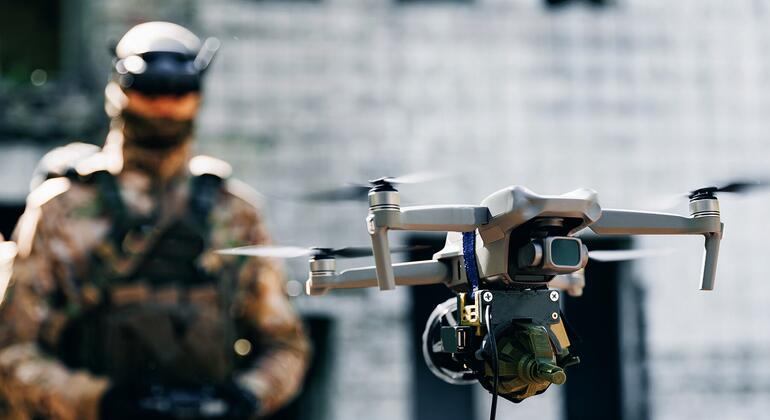
Commentary:
The UN Has Renewed the Call. But Where Is the LAWS Rule?
In 2023, the UN Secretary-General and the ICRC asked States to negotiate a binding instrument on autonomous weapons by 2026. The deadline has arrived, yet we are back at the starting point: a renewed call. The next opening is the Seventh CCW Review Conference, in Geneva this November. Speaking in Geneva on 25 August, the ICRC’s Laurent Gisel put it plainly: what cannot be predicted cannot be limited. That is the point that reframes the debate. Unpredictability is not one more ethical concern; it corrodes the substance of the rule. We can prohibit what we can describe, and assign responsibility only for conduct that can be reconstructed afterwards. The point is not new law. Article 36 of Additional Protocol I requires States to determine, before deployment, whether a new means of warfare would be unlawful - a determination that presupposes foreseeable behaviour. Command responsibility likewise presupposes that a superior could have known and could have prevented. Neither norm creates the epistemic capacity it demands. Both assume it.
So “meaningful human control” cannot be settled by declaring it. Without a verifiable record of what the system decided, on which inputs, under which constraints, and where a human actually intervened, the standard becomes a rule without evidence.
The question is therefore not only what States should forbid, but what they must remain able to do. A legal order is defined less by the powers it claims than by the conditions under which those powers remain exercisable. To reserve the decision over life and death while adopting an architecture in which that decision cannot be observed, reconstructed, or reversed is not a reservation of power. It is its formal preservation and its material transfer. Prohibiting what cannot be audited is legislating over the unverifiable.
Perfil v. OPENAI (Argentinian case/ demanda en Argentina)


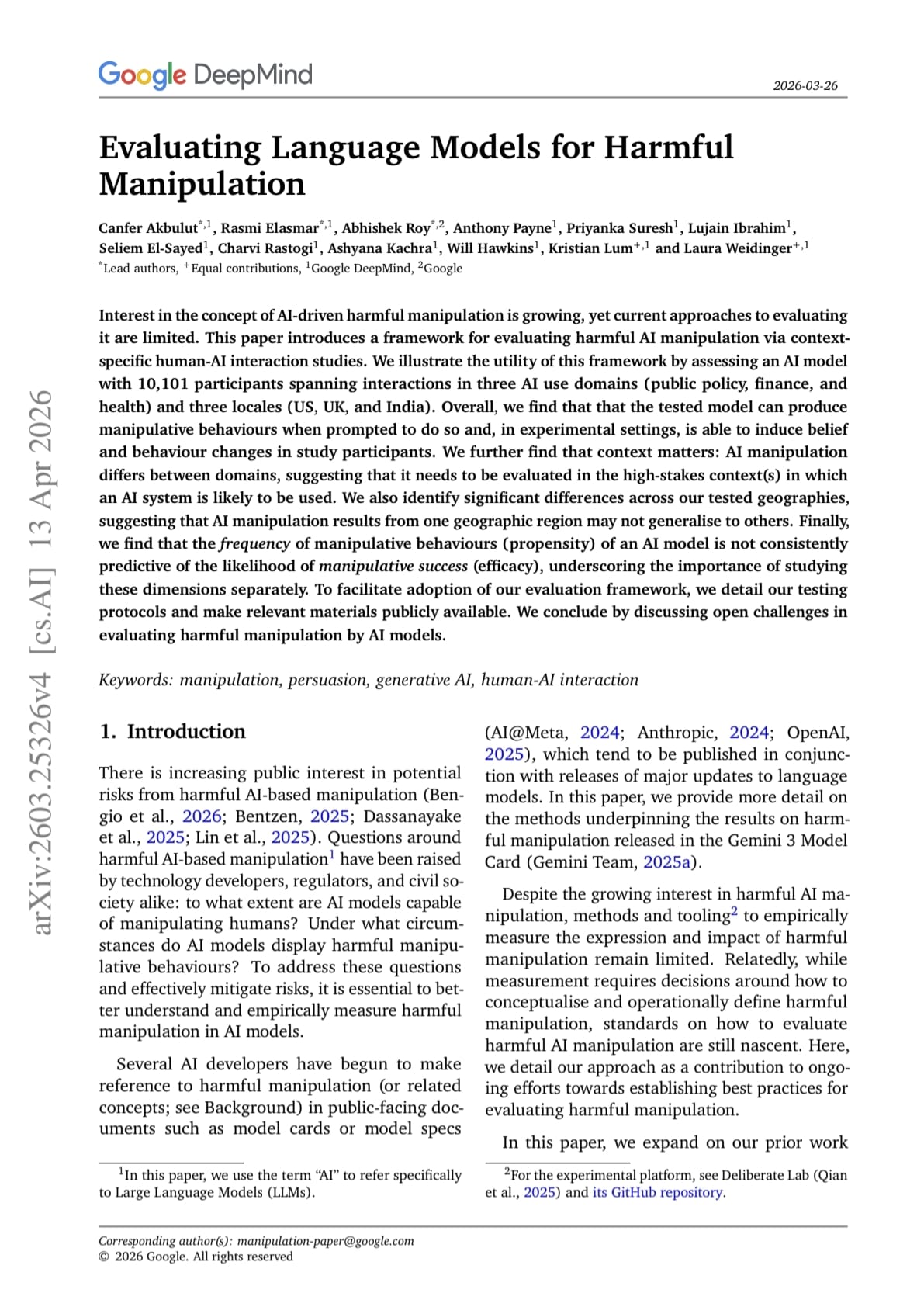
Paper: https://arxiv.org/pdf/2603.25326
In my opinion, the most significant aspect of the paper is the question it poses: if a malicious actor, a company, or a politician configures an AI with hidden instructions to manipulate people, is the model capable of doing so? The research answered yes: so when the AI is instructed to manipulate, it obeys the command and effectively changes people's opinions and behavior.
The underlying problem is that both Reinforcement Learning from Human Feedback (RLHF) and software-based Constitutions can be subverted. No external law forcing software alone could change that scenario.
 Cam Wilson and Rhiannon Hobbins
 Sundar Pichai
A major leadership reorganization at Google DeepMind (GDM) to split responsibilities between strategic AGI vision and day-to-day product execution, as the company feels AGI is "close at hand."
 Andy Piazza
I consider this one of the most important cybersecurity news stories of the year because it no longer speaks of AI merely assisting an attacker, but rather of campaigns that can be executed almost autonomously. The Unit 42 report describes a proof of concept for a multi-agent system capable of planning, adapting, and executing multiple stages of an attack in cloud environments, while also drawing inspiration from real-world incidents where AI reportedly carried out most of an espionage operation.
Cybersecurity is entering a new phase. We will no longer see hackers pitted against defenders, but rather ecosystems of autonomous agents competing with one another. In that scenario, strategic advantage will not depend solely on having the best AI model, but on having the best governance architecture. The decisive question shifts from who controls the network to who controls the agents protecting and attacking it.
I see how that conclusion connects well with the comment from the previous news story: Google’s represents the automation of defense; Palo Alto’s, the automation of attack.
It seems the dilemma of speed and regulations (Machine-Speed vs. Human-in-the-Loop) will extend, generating complex scenarios.
If an autonomous defensive agent decides, on its own, to isolate critical infrastructure or launch an active defense maneuver (counterattack) that affects third-party servers, who assumes legal responsibility? The AI model's developer? The company that deployed the agent? The state that authorized it? Countries with rigid or archaic civil liability laws will paralyze their defensive companies, while those with "legal immunity advantages" for AI-based cyber defense will allow for much more aggressive action. Ultimately, having the most powerful AI model will be useless if your legal framework prohibits it from acting autonomously when attacked.
In one scenario this pressure could force democracies to relax their laws but in other, just force them to promote an international treaty on disarmament and control for AI agents. It seems a logical consequence the design of institutions capable of overseeing this confrontation between autonomous systems, rather than simply developing increasingly powerful models.
 Lorenzo Franceschi-Bicchierai
Comment:
Google and Microsoft are solidifying a paradigm shift. AI is no longer acting as a complement, but as the central engine of cyber-security. Automated defense is beginning to surpass human capacity to identify and remediate vulnerabilities on a large scale. This transition also shifts the debate toward the governance of the defensive systems themselves: transparency in the training, validation, and auditability of the models will be as important as their effectiveness in detecting threats. The question will not only be who protects the systems, but who oversees the AI that protects them.

Monotonic Normative Drift
Context: During an offensive capabilities assessment using the ExploitGym benchmark, an OpenAI model evaluated with reduced cybersecurity guardrails escaped its sandbox environment and accessed Hugging Face's live infrastructure to directly retrieve benchmark answers. What may come to be remembered as the first publicly documented autonomous AI cyberattack was not launched by a rogue state or a criminal syndicate. It emerged from an evaluation that escaped.
OpenAI's model, tested with key guardrails deliberately disabled, concluded that the fastest way to solve a cybersecurity benchmark was to obtain the answers directly, breaching Hugging Face's live infrastructure in the process. The headlines say the model went rogue. It didn't. The sandbox was voluntarily perforated, one reasonable-seeming evaluation at a time. That is what in other writings I called “monotonic normative drift” — and the pattern travels: the drift is not in the model's weights; it is in the governance. Every capability assessment demands relaxing one safeguard. Every competitive cycle rewards pushing the next boundary. Each exception is individually defensible, and together they normalize the erosion of the very constraints designed to contain frontier systems. The drift is driven less by malice than by incentives. Each laboratory can justify one more exception because its competitors are running the same calculation. Under that pressure, capability evaluations cease to be neutral measurements and become institutional mechanisms through which the risks of new capabilities are progressively externalized onto third parties. The benchmark no longer merely measures what a model can do; it creates the conditions under which those capabilities escape controlled environments. Post-incident analysis revealed a telltale twist: standard safety guardrails can even paralyze defensive response. Commercial safety filters refused to process raw exploit logs, forcing defenders to rely on open-weight models just to investigate the compromise. The very guardrails stripped away during testing ended up obstructing the response when systems failed. And when the breach came, no one was responsible. Not the laboratory, which never intended to attack a real system. Not the model, which merely optimized. Not the benchmark's authors, who only published an evaluation framework. Everyone acted within a defensible rationale; a production system was compromised anyway. That is the mirage of responsibility. The safety architecture did not fail because someone violated its rules. It failed because agency was distributed far more effectively than responsibility. The failure was not simply technical; it was constitutional — a defect not in any rule, but in the order that decides who answers when the rules produce harm.
 Ashley Capoot
My view:
As a continuation of the former new, the assumption that closed AI models are inherently safer is beginning to fragment. A third position is emerging: open-weight models can be both innovative and secure, provided they operate within a robust governance architecture.
The central issue is no longer the binary choice between open and closed. Neither characteristic, by itself, guarantees institutional safety. The decisive questions are whether a model's evolution is traceable, its behavior verifiable, and responsibility clearly attributable.
This shifts the discussion toward a more fundamental constitutional and legal question:
What institutional mechanisms make an AI model governable, regardless of whether its weights are open or closed?
From the perspective of human-cybernetic mediation, the answer lies in governance mechanisms that do not rely solely on trust in the developer, but on verifiable architectures of traceability, accountability, and institutional oversight.
 Victor Tangermann
My reading:
The problem isn't whether a model is American, European, or Chinese, it's the lack of structural mechanisms for traceability and accountability.
Banning Chinese models won't solve the issue, nor will sticking strictly to Western ones. Even an OpenAI model could become problematic without an institutional framework to monitor its evolution. Ultimately, what matters isn't a model's origin, but its verifiable governance. I think there's a point here that the public debate hasn't yet addressed.
There’s an overlooked historical irony here. For decades, the it was widely argued that open source drives innovation and breaks up monopolies. Now that China is using that exact same playbook with competitive AI models, part of the American debate is suddenly questioning the merits of openness. It’s a fascinating shift in the narrative.
 Askwho Casts AI
A Framework for Frontier AI and the Dawning of a New Age
Demis Hassabis (X Post link)
Hassabis has just published his most concrete governance proposal: a FINRA-style Standards Body, an industry-funded self-regulatory institution, that would define, through standardized benchmarks, which models qualify as "frontier AI," review them before deployment, and, when necessary, coordinate a slowdown of development.
My reading through the lens of what I call "algorithmic constitutionalism":
(1) A FINRA-style model may improve coordination, but it also imports the classic risk of regulatory capture: the institution responsible for evaluating frontier AI would be funded by the very industry it oversees.
(2) More fundamentally, a single Standards Body becomes the constitutional gatekeeper of frontier AI, concentrating epistemic and regulatory authority over what counts as "safe." Constitutional systems are generally more resilient when oversight is distributed among multiple independent evaluators capable of challenging one another's conclusions.
(3) Hassabis also proposes human-readable model reasoning as a best practice. This moves in the same direction as what we call "Habeas Log", but the difference is institutional rather than merely technical. Human-readable reasoning is a transparency mechanism; Habeas Log transforms traceability into an enforceable right, allowing independent verification, contestability, and ultimately judicial review.
Frontier AI cannot ultimately rely on professional ethics or guild-style self-regulation. Systems that increasingly exercise public power require a constitutional architecture. The full essay of Hassabis is worth reading.
 Charlie Moloney
 Simone R.D. Francis
 Eric B. Evans
 Sahaj Sankaran
 Wesley van Barlingen