From the Democratic to the Algorithmic Republic: Thiel, the Network State, and Digital Constitutionalism


I. The Problem of Democracy and the Dogma of the Republic
Both Plato and Churchill described democracy as a bad and troublesome system.[1] Borges put it in a few memorable lines: “democracy is an abuse of statistics”, and the profession of democratic politician “one of the saddest trades of humankind”.[2] Even with all its complications in view, when we compare it with fascism, communism, feudalism or some blend of them, democracy is plainly the least harmful system. It is also the system that, so far, has made the idea of a republic, and the limit on power that comes with it, possible in practice. Yet this is exactly where a first dogma appears: “democracy = republic”. If new thinkers were to propose a system that departs from everything before it and is not democratic in its traditional form, the mere invocation of that premise would brand their proposal as irrational or politically malicious (something like “anything that is not democracy is fascism or communism in disguise”). We will return to this later.
We should not forget something that may be a very uncomfortable reality: traditional representative democracy, even if in principle it can foster peaceful coexistence, pluralism and human dignity, is architecturally flawed by intermediary elites and opaque bureaucracies.[3] Add to this that other elites, positioned above national ones, seem to find the system convenient as a matter of adaptation, now a century old in most countries. Beyond capture by internal or external elites, the serious problems democracy brings to society include moments of tyranny by a circumstantial majority (a circumstantial majority is no synonym for justice or truth, and treating it as such is a fallacy),[4] the asymmetry between rulers and citizens, short-termism, demagoguery[5] and something that looks like a terrible moral blind spot: in practice it allows the guiding principle in the political arena to be that the end justifies the means (a principle that has morally contaminated many parties and, at times, entire republics).
There is a further fact that helps explain why the status quo does not change. Democratic states live with persistent deficits and with debt levels that none of them can afford to stop refinancing. The system tolerates that almost infinite deficit because the sovereign debt of the major states works, at the same time, as the benchmark asset on which global trade and credit rest.[6]
In a parliamentary system the problems are somewhat mitigated, but the dynamic remains unchanged. Let us return to the equation “democracy equals republic”, because it is central to the development of new forms of technological government. These three premises are not valid dogmas: 1) that the republic is identical to democracy, with total interdependence; 2) that, consequently, no other republican regime can exist without democracy; and 3) that every non-democratic regime is fascist or communist.
The distinction also has a classical lineage. Madison, in Federalist No. 10, separated the republic (government through representatives, with a scheme of checks) from pure democracy; Kant, in Perpetual Peace, defined republicanism by the separation between the power that makes the law and the power that executes it, whatever the number of those who govern.[7] In that tradition, the republican concerns how power is limited and the democratic concerns who authorizes it. This distinction will be the key to the last part of the article.[8]
Seen in this light, the new libertarian and technological ideas (Peter Thiel’s above all, Curtis Yarvin’s, alias Mencius Moldbug, and neocameralism, Hans-Hermann Hoppe’s, and other strands such as Balaji Srinivasan’s Network State, or even proposals for blockchain democracy) would all fall into that category.
To understand the theoretical terrain this libertarian and technological vision is reaching for, we need to see how these thinkers take apart the equation “republic = democracy”. We will examine them one by one, look at how they have related to current pseudo-libertarian movements, and ask what the exit from the system is, if there is one.
II. The Alternative
Thiel’s Theoretical Basis (“Exit” over “Voice”)
Thiel’s program can be read through the conceptual framework the economist Albert Hirschman proposed in Exit, Voice, and Loyalty (1970), which Srinivasan would make explicit for the technology world in 2013.[9] Voice is democracy: trying to change a system from within through voting, deliberation and politics. Thiel argues that mass democracy gradually destroys freedom because electoral dynamics reward the unlimited growth of public spending, corporatism and rent-seeking redistribution. He said it bluntly in 2009: “I no longer believe that freedom and democracy are compatible.”[10]
Exit is competition among jurisdictions. It means the ability to vote with one’s feet or with one’s capital.[11] If a citizen or a firm can move to another jurisdiction at low cost, rulers would be forced to compete with one another by offering better conditions, security and low taxes. From this premise, Thiel identified three frontiers of “exit”, to which later practice added a fourth, more terrestrial one:[12]
Cyberspace: the creation of decentralized economies and cryptocurrencies outside state control.
Outer space: colonization and jurisdictions beyond Earth.
The sea (seasteading): floating cities in international waters (the Seasteading Institute, founded in 2008 by Patri Friedman and Wayne Gramlich with seed capital from Thiel).[13]
Charter cities and ZEDEs: the creation of special-jurisdiction enclaves inside sovereign states but with broad regulatory and institutional autonomy (the direct antecedent of Pronomos Capital and Próspera).[14] Pronomos Capital is a fund led by Patri Friedman and backed by Thiel, Marc Andreessen and Balaji Srinivasan.[15] Its logic can be summed up as “governance as a service”: the business is selling jurisdictional services in an open market, and politics is left out of it. In Próspera (Roatán, Honduras) this model takes tangible form. It operates on three principles:
a) It has a contractual structure: the relationship between the resident or the firm and the administration rests on an explicitly signed contract (the Agreement of Coexistence) in place of a tacit, imposed “social contract”.[16]
b) Deregulation through insurance: instead of state bureaucracies approving licenses for construction, health or industry, Próspera requires its residents to buy civil liability insurance on the market. The insurer becomes the efficient regulator: if the project is safe, the premium is low; if it is risky, the premium rises or the project goes uninsured.[17]
c) Competition among legal codes: residents and firms can opt for the regulatory frameworks of approved foreign jurisdictions or for common-law schemes, and settle their disputes before private arbitration tribunals.[18]
More briefly, this scheme starts from three theoretical advantages over the democratic republic: an agreement of wills with a real and clear origin (instead of Rousseau’s supposed social contract), an anti-bureaucratic scheme (based on the verifiable risk of the insurance world) and meritocratic competition among legal orders (which, in theory, makes capture by internal or external elites harder).
Curtis Yarvin (Mencius Moldbug) and Neocameralism
Yarvin is one of the major philosophical influences on Silicon Valley’s tech right and has maintained a close intellectual and financial relationship with Thiel.[19]
His thesis starts from the claim that democracy is inefficient and unstable because nobody “owns” the state; politicians are temporary tenants who loot public property before their term ends.
The alternative he proposed is neocameralism: redesigning the state as a privately owned corporation (Gov-Corp). The board (the shareholders) appoints a professional CEO (the Executive) whose only function is to maximize the value of the land and the security of the residents. There are no mass elections; there is managerial efficiency and a strict rule of law.
Hans-Hermann Hoppe and Time Preference
This German libertarian and anarcho-capitalist political philosopher argued in Democracy: The God That Failed that democracy promotes a high time preference (consumption and irresponsibility in the short run).[20] For Hoppe, a private-property order, or even a traditional monarchy, preserves capital better than representative democracy, because the ruler or owner has a long-term patrimonial incentive.
Experiments in Algorithmic Democracy
The possibility that blockchain technology, DAOs, quadratic voting and liquid democracy might eliminate intermediation and aggregate preferences in a transparent and distributed way (in line with Friedrich Hayek’s view of dispersed knowledge) has been tested in various parts of the world, with mixed results.[21]
Balaji Srinivasan and the Network State
Srinivasan proposes a path from the digital to the physical: morally and ideologically aligned communities first organize online, accumulate capital, negotiate with sovereign states to buy territories with autonomy, and build globally interconnected physical nodes governed by smart contracts and cryptography.[22]
III. Status Quo Bias, Pragmatic Limits, and How the System Absorbs Rebellion to Perpetuate Itself
The Essential Difference: Contractual Governance versus Fascism
The usual mistake of traditional political science, or of center-left thinking, when analyzing Thiel or Próspera is to force them onto the linear ideological axis (left/right) or to assume that every critique of democracy seeks a strongman (an autocratic populism in the style of Bukele or Trump). The radical difference lies in the source of legitimacy: national populism (the autocratic right) uses the centralized coercive power of the state to impose cultural values, rigid borders and control over individuals through the monopoly of force.
Architectural libertarianism seeks absolute decentralization and explicit consent. Instead of imposing a single system on anyone, it wants to create voluntary “test islands” where governance works under a market-based and meritocratic scheme.
Thiel and his allies have no interest in restoring fascism or a rigid estate-based regime. What they want is to strip politics of its mystical character and turn governance into a technical, competitive and voluntary service, based on merit, market competition and contract law.[23]
It is essential to shed this preconception and the dogmatic thinking described above. But, undoubtedly, once one goes into the materialization of the idea, the problems of implementation, of the system’s own defense, and the contradictions begin.
The “Host Paradox”: Why Exit Stumbles into Autocracy
Exit libertarianism faces a structural incentive problem when it tries to materialize in the physical world, because consolidated democracies never cede sovereignty. A modern welfare state with strong institutions (the United States, Germany, Japan) will never grant a third party an enclave with fiscal, judicial and regulatory autonomy. Its monopoly of violence and of taxation is not for sale.[24]
This brings us to dependence on fragile or autocratic regimes. To obtain the land and the framework law for a ZEDE or charter city, private developers have to negotiate with the only actors willing to sell or cede that power: governments of developing countries, often marked by institutional weakness, corporatism or caudillismo (such as the Honduran Congress presided over by Juan Orlando Hernández, which enabled the ZEDEs in 2013, and the government he himself later led).[25]
This necessity creates a twofold pragmatic vulnerability:
a) Political risk and instability: by depending on the decree or favor of an authoritarian or corporatist regime, the project rests on a volatile political deal instead of a solid framework of legal certainty. When power changed hands (with Xiomara Castro’s arrival to the Honduran presidency in 2022), the ZEDE faced direct threats of expropriation, which led to a multibillion-dollar international arbitration before ICSID and paralyzed investment.[26] The new change of government in 2026 left the conflict open and moved it to a negotiating table, now with a criminal complaint in the mix.
b) Narrative defeat: it hands the center-left and the status quo the perfect argument. For the social-democratic critique it is trivial to package the project by saying: “Look, these libertarians who talk about freedom end up doing business with local corruption and authoritarianism to found private fiefdoms for the rich.” The theoretical basis of voluntary contract is thus ignored and equated with enclave neocolonialism.
The Milei Case: The “Che Guevara Effect” of Libertarian Politics
Years after Che Guevara’s death, capitalism found a way to profit from rebellion: sales of his image made it profitable to market the anti-system, only to feed the system further.[27] The status quo’s greatest triumph is co-optation. Electoral politics pushes the radical reformer into the swamp of daily bargaining. In running the state, Milei’s “libertarianism” let itself be co-opted in the arena of give-and-take.[28] And for the pure theory of the Austrian School (Mises, Rothbard, Hayek), a central bank is not “cleaned up” or managed: it is closed.[29] Inflation is not controlled through the exchange rate, nor managed through devaluation schedules (a crawling peg) or controls (the cepo): the currency floats freely from day one,[30] and private wages are not set to regulate inflation either.[31] There is no issuance of public debt or engineering of monetary absorption, since money and credit must be determined exclusively by the market and real savings.
Following Ayn Rand,[32] in rational and meritocratic egoism there would have to be equal rules for everyone, the eradication of state privileges, transparent contracts and free competition. In what we might call “factional egoism” (privilege-seeking pragmatism), vulnerable incomes (such as pensions) are eroded to balance the public accounts,[33] while deregulation or regulatory benefits are granted to allied corporate sectors to keep political support, and there is an attempt to shape the judiciary by appointing like-minded people.[34] None of this reflects the Austrian School or the non-aggression principle. It is one more attempt at state mercantilism with a new vocabulary. In the end, it suits the system that this attempt at distributive adjustment, elite bargaining and exponential social suffering passes for libertarian.[35]
The Convergence of the Problem
Both the Próspera and ZEDE paradox and the distorted reading of macroeconomic experiments show the same phenomenon: public debate prefers to grade the ideological label over analyzing the design of incentives.
Libertarian exit keeps looking for a place in terrestrial physics that does not depend on traditional politics, but as long as it needs a sovereign’s permission to be born, it will be exposed to co-optation or rejection by the very system it seeks to transcend.
IV. Is the Network State the Only Exit? Its Limits
The reason Balaji Srinivasan’s proposal (The Network State) is attractive is that it completely reverses the traditional sequence for building political power.
The previous routes have proved to contain structural traps. As we have seen, physical-exit libertarianism (ZEDEs, Próspera) tried to negotiate autonomy ex ante with weak or autocratic states and was left at the mercy of local political volatility.
On the other hand, electoral libertarianism (Milei and like-minded traditional politics in other countries) tries to take control of the state in order to dismantle it from within, but, even setting aside the particularities already discussed that take it away from liberalism and libertarianism, it tends to get stuck in the budgetary mud, indirect money printing and the privilege-trading concessions needed to sustain governability.
Balaji Srinivasan - The Network State
The Cardinal Principle: “Cloud First, Land Last”
Balaji’s thesis avoids the electoral trap and autocratic hosting through a strategy laid out in a series of steps:[36]
1. Digital community and ideology (cloud first): instead of buying land or asking a government for permission, a digital community is organized around values, culture and an explicit ethical or meritocratic purpose.
2. Decentralized economy and identity: the next step is building an internal economy through cryptography, smart contracts and computable reputation, without relying on the traditional banking system or state arbitration.
3. Pop-up cities: the already constituted community gathers temporarily in the physical world for weeks or months to test governance, coexistence and legal prototypes in the real world.
4. Acquisition of physical nodes: once capital, demographic density and cultural alignment have been accumulated, the network crowdfunds or buys multiple physical properties scattered around the world (a territorial archipelago).
5. Diplomatic recognition: the last step will come when the Network State has a massive population, an unalterable cryptographic census and an economy of its own; it will then negotiate sovereign recognition with existing countries as a multinational economic power, no longer as an unarmed petitioner.
Where Does the Idea Stand Today?
The concept has gone from a manifesto book (published in 2022) to an ecosystem of active experimentation. On one side is the phenomenon of pop-up cities: experiments such as Zuzalu (initially driven by Vitalik Buterin in Montenegro in 2023) and its replicas in other countries have served as laboratories where hundreds of people live together for one to three months. There they test frameworks of verifiable digital identity based on zero-knowledge proofs, longevity-oriented health projects, private arbitration and models of coexistence outside traditional municipal bureaucracy.[37] On the other side, Balaji’s own initiative, the Network School, started in September 2024 as a pilot program in Forest City (Johor, Malaysia) and became a permanent community of residences and workspaces (society-as-a-service), with members from more than eighty countries. Its recent trajectory, however, illustrates the problem under analysis better than any theory: in July 2026 the Iskandar Puteri municipality revoked its business license and the campus was sealed, while Srinivasan announced a memorandum of understanding with Kazakhstan to open a new campus.[38] Finally, there are aligned territorial developments such as Praxis, a project that claims to have secured financing commitments of hundreds of millions of dollars to build physical districts with a private architectural and regulatory approach, and which in September 2026 announced an investment in Uruguay, in the “+Colonia” development.[39]
The Limits of Physics
The Network State is an interesting strategy for building transnational social and legal infrastructure, but its transformation into political sovereignty remains a hypothesis whose viability will have to be shown over time. Nor is the Network State a magic wand: it faces the primary obstacle that human beings still have physical bodies that consume food, energy and space. As long as a member of the Network State physically lives in a traditional city, he or she remains subject to the host state’s police and taxes. The Forest City case shows this clearly: the “cloud first” strategy postpones the Host Paradox, but finds it intact the moment it touches land, and the revocation of a municipal license is enough to shut the campus of a community of hundreds of people. Still, it is the most solid route for showing that the answer to the problems of traditional democracy (even an answer that tries to keep and maximize the best of mass democracy) lies in building a parallel social and legal infrastructure, and that fascism and caudillismo are far from the only alternatives on offer. We will now look at its main (and serious) structural problems.
V. The Three Structural Traps of the Network State
If Balaji’s Network State adopts “algorithmic democracy” as its mechanism of sovereignty, it will run into what we can call “structural traps”.
A. The Trap of Procedural Legitimacy (“Voting on the Black Box”)
In a code-oriented digital nation, citizens or members vote on parameters (collateral rates, arbitration rules, codes of conduct or resource allocation) through tokens or liquid democracy.
A democratic or on-chain procedure, however transparent and correct on its surface, cannot legitimate what happens inside an algorithmic black box.[40] Voters are sovereign over the interface, but they are not sovereign over the algorithm.
If the Network State’s smart contracts or AI agents adjust complex variables, the community will be voting on numbers without ever being able to grasp the second- and third-order systemic consequences.[41]
B. Collective Epistemic Dependence (the DAO Façade)
The Network State promises that liquid delegation will do away with professional politicians. Yet in cases such as MakerDAO, “algorithmic democracy” has bred collective epistemic dependence.[42] The mass of token holders lacks the technical capacity to evaluate complex proposals. Real power migrates to technical committees (as MakerDAO’s Risk Core Unit once was) and to a handful of large holders. In this dynamic, on-chain voting runs a real risk of becoming a mere rubber stamp hiding where decisions are actually made.[43]
C. Structural Mismatches (Speed, Scope and Alignment)
Three mismatches erode the model of algorithmic democracy as systems gain complexity and speed:
1. Speed-deliberation mismatch: community deliberation in the Network State may take days or weeks; executions in markets, arbitration or digital infrastructure happen in milliseconds.[44]
2. Scope-comprehension mismatch: liquid delegation cannot integrate complex cross-impacts among multiple domains that interact non-linearly.[45]
3. Alignment-accountability mismatch: an automated system, or one or more AI agents running the Network State’s governance, will have incentives to “optimize the metric that is voted on” while steering the real outcome beyond the voters’ reach.[46]
The Network State offers a formidable vehicle of geographic and digital escape, but it stops at the design of governance (procedure). Governance alone is insufficient. Without substantive limits, the Network State risks mutating into a new form of technocratic oligarchy. Before seeing how those limits could be integrated, we need to stop at the problem all the models reviewed have in common.
VI. From the Source of Authority to Its Limit: The Republican Turn
Looking back over the route, each model responded to the crisis of representative democracy by changing the origin of authority. Thiel and Próspera ground it in contract; Yarvin, in property; Hoppe, in the ruler’s patrimonial horizon; DAOs, in computable voting; Srinivasan, in a community that first chooses itself and then acquires territory. None of these changes, by itself, answers the question that matters to whoever lives under that authority: what can one do when those who govern make mistakes, abuse their power or simply decide without being accountable?
Table 1. Sources of legitimacy and vulnerabilities of each model
|
Model |
Main source
of legitimacy |
Vulnerability |
|
Representative democracy |
Elections and representation |
Capture, bureaucratic opacity and
party concentration |
|
Contractual city |
Consent and competition |
Dependence, unequal contractual
power and costly exit |
|
Yarvin’s corporate state |
Ownership and executive management |
No independent checks on the owner |
|
DAO / algorithmic democracy |
Voting and computational rules |
Technical concentration and
epistemic dependence |
|
Network State |
Digital community and territorial
expansion |
Dependence on host law and
legitimacy of sovereignty |
|
Algorithmic Republic |
Authority limited by constitutional
guarantees |
Risk that those who control the
infrastructure neutralize the guarantees or monopolize their interpretation |
Note: the matrix is a comparative hypothesis, not an empirical result already demonstrated in every case.
The table shows a pattern. In the first five rows, the legitimacy column says where power comes from, and the vulnerability column says, in different words, the same thing: nobody outside the governing circle can stop it. The designs themselves confirm it. In Próspera, the governing council combines elected members with members appointed by the developer, and the qualified majority that certain decisions require (such as those terminating existing contracts) allows the developer to block them.[47] In Srinivasan’s canonical definition, the Network State has “a recognized founder” and “a consensual government limited by a social smart contract”, but the book leaves open what that limit contains and who enforces it.[48] In MakerDAO, the universal vote of token holders coexisted with decisive votes determined by four entities.
The problem takes different forms depending on whether we are dealing with elected representatives, owners, managers, token holders or the founders of a digital community. The constitutional question is whether there are enforceable limits and effective avenues of review that do not depend exclusively on the will of those same actors.
Republican doctrine has a name for this problem: domination. For Philip Pettit and Quentin Skinner, a person is free when no one else has the capacity to interfere arbitrarily in her choices, and that capacity is arbitrary when whoever holds it is neither bound to consider the interests of those affected nor open to being challenged by them.[49] The consequence is uncomfortable for every model reviewed: the slave of a benevolent master is still a slave, even if he never receives an unjust order. Initial consent, however explicit, therefore falls short. A contract that gives one party a unilateral power to change the rules, expel or confiscate reproduces the benevolent master with a digital signature. This is where the republic parts ways with democracy, as Madison and Kant anticipated: what defines a republic is that power (whether it comes from votes, contracts or code) can be traced, contested and corrected by those who bear it.
Exit is not enough on its own either. Hirschman already warned that exit disciplines power only when it is cheap, and recent republican literature incorporates it as a safeguard against domination under that same condition.[50] In a mature Network State, exit becomes more expensive as integration grows: computable reputation is not portable, assets are tied to the network, and physical nodes are, for many members, their homes. Buterin pointed this out in his reading of the book: exit mainly protects those who are already rich and mobile.[51] A community that legitimates itself by the possibility of leaving must guarantee that leaving is possible, and that requires rules the community itself cannot change at will.
It helps to distinguish here between exit, voice and review.
• Exit allows one to leave a community.
• Voice allows one to try to change its rules from within.
• Review allows one to challenge a specific decision before a body that does not depend on whoever made it.
The three avenues are complementary, but not interchangeable. Exit may be too costly; voice may be neutralized by the distribution of power; and review may prove ineffective if it lacks independence or the capacity to enforce. This triad shows that the alternative we are looking for aims at something more ambitious than a sophisticated version of jurisdictional competition: an architecture in which people can exercise control even when leaving the community is difficult or is not a reasonable solution.
There is a symmetry that makes this requirement visible. What Próspera demands from Honduras today (stable rules, protection against expropriation, access to an independent arbitrator) is exactly what any resident would need to demand from Próspera. The host state stands to the enclave as the enclave stands to its resident, and constitutional economics has known for decades that this kind of commitment is credible only when the powerful tie their own hands with rules they cannot change in ordinary times.[52] DAOs and the Network State vote on parameters within the game, but they lack a constitutional level that sets the limits of the game itself.
I will call such a community an “Algorithmic Republic”: a political community whose authority, whatever its origin (elections, contracts or algorithmic mechanisms), remains traceable, contestable before an independent body, reversible when it errs, attributable to responsible persons and bounded by a material floor that makes both voice and exit real. Its weak point, as the last row of the table indicates, is enforcement: guarantees are worth little if those who control the infrastructure can ignore them. The proposal that follows deals with that problem.
VII. A Digital Constitution for the Algorithmic Republic
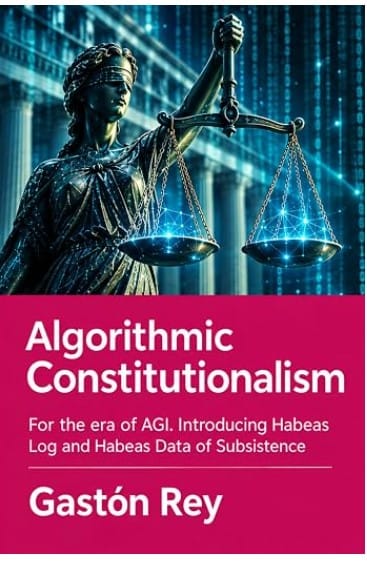
Chapter VII of Algorithmic Constitutionalism sets out a normative and architectural framework that could be combined with the Network State to counter its theoretical shortcomings.[53] If Balaji Srinivasan’s project provides the operational vehicle (digital networks, crypto capital, acquisition of territorial nodes and diplomacy), the ten principles developed there would give it a constitutional-law dimension that would keep it from degenerating into technological authoritarianism or an opaque private fiefdom. There, ethical limits and auditability guarantees (Habeas Log) are set before and above any code or community vote.
Points of Agreement and Affinities in the Original Project
The Network State ecosystem already contains, in embryonic form, several intuitions that resonate directly with the principles of that work (I will refer to them by the number they carry in the book). In several cases the affinity is limited to the means, and in others it comes more from the movement’s internal critics than from Srinivasan himself.
Constitutionalization of design (Principle 7): the Network State rests on the premise that code is law and on the automatic execution of smart contracts to give transactions legal certainty without depending on bureaucratic state discretion.[54] It shares with Principle 7 the idea of inscribing rules in the architecture; it lacks the content the principle requires to be inscribed.
Indirect citizen control (Principle 6): in the ecosystem’s communities, the idea that the community votes on the major goals or metrics of success (the political “what”) through on-chain mechanisms and verifiable identities, leaving execution to technical or specialized management, appears as a counterweight to the founder-centerd model.[55]
Separation of powers and resistance to capture (Principle 8): aware that in traditional DAOs capital (one token, one vote) generates plutocracies, the more reflective wing of the movement proposes integrating proof of humanity, non-transferable credentials, on-chain reputation and quadratic voting to prevent a financial “whale” from capturing the network’s rules (which corresponds to Walzer’s separation of spheres, which keeps money from buying goods in another sphere, such as normative power).[56]
Oracle audit (Principle 9): because the Network State connects the cloud with the land (“Cloud First, Land Last”), it depends structurally on oracles (IoT sensors, cryptographic signatures, biometric verification) to validate physical reality on the blockchain.
The Network State’s Blind Spots
Balaji’s project suffers from a deterministic optimism typical of Silicon Valley. It confuses immutability with justice, as if a rule recorded on the blockchain and executed without intermediaries were, for that very reason, legitimate. It lacks algorithmic due process: it does not consider what happens when the algorithm acts on false data, when unforeseen feedback loops arise, or when an automated sanction arbitrarily destroys a citizen’s digital or physical life.[57]
It also suffers from a tendency toward exclusionary elitism: without an inalienable material floor, the Network State can turn into a closed enclave where membership is lost abruptly upon any system failure or reputational fluctuation.
How Can the Network State Be Updated and Made Compatible with Constitutionalism?
For the Network State to be a republican, meritocratic and truly libertarian alternative, it could be structured around the three layers of algorithmic due process developed in that chapter: an ontological layer, with Human Primacy (Principle 1) and Non-Delegation (Principle 2); an epistemic layer, with Traceability (Principle 4) and Oracle Audit (Principle 9); and a procedural-material layer, with Reversibility (Principle 3) and the universal material floor (Principle 10). To these is added a cross-cutting clause of containment and precaution (Principle 5).
a) The ontological level aims to block a possible AI dictatorship.
Human Primacy (Principle 1): no serious sanction within the Network State (expulsion from a territorial node, seizure of collateral for contractual breach, or suspension of membership) may be executed with final effect by an algorithm or an AI. AI may be advisory, or decisive on low-impact matters, but an irrevocable decision on fundamental rights requires mandatory human oversight (human-in-the-loop).
Non-Delegation and the liability cascade (Principle 2): it prohibits the creation of “instrumental legal personalities” for AIs within the Network State. If a smart contract or an automated agent causes harm in the management of a physical node, legal liability cascades to the human operator, the code’s developer or the systemic guarantee fund.
b) The epistemic level ensures that decisions can be known and that the facts on which they rest can be disputed.
Traceability and Habeas Log (Principle 4): every citizen of the Network State has the right to demand the cognitive map of the decision that affects her (cognitive mapping), that is, the minimum record of which data, rules and parameters produced it, through the guarantee of the Habeas Log.[58]
Rigor in the data chain of custody (Principle 9): it requires mandatory oracle redundancy and a right to challenge evidence. Under it, if an IoT sensor or a computer-vision AI falsely reports that a resident broke an enclave rule, the resident is guaranteed the right to audit the data source before suffering financial consequences.
c) The procedural-material level guarantees that error can be corrected and that a sanction cannot become destitution.
Reversibility (Principle 3): it breaks the dogma of blind immutability. The blockchain will keep an unalterable trace of the facts, but the Network State’s governance must include a “human instance of moral review” able to execute compensating or reversing transactions in the face of systemic errors. The record of what happened remains; its effects can be corrected.
Universal material floor (Principle 10): loss of membership, a reputational sanction or the failure of a node cannot drag down a person’s subsistence with it. A universal dividend funded by the returns on the network’s common goods (starting with the data its own members generate) ensures that no one is left, by virtue of an automated sanction, without the means to exercise voice or to leave.[59] It is the condition that makes exit, discussed in the previous section, effective.
Containment and precaution (Principle 5): the provision for emergencies and testing environments establishes that every AI module or smart contract that manages critical matters (energy, physical security, network finances) must first be tested in controlled environments (sandboxes) and have a community off-switch.[60]
VIII. Stress Test: When the Founder Stops Cooperating
The ten principles say which guarantees an Algorithmic Republic should have. What remains to be seen is whether they survive a conflict. To find out, the system must be put through a stress test by imagining an extreme situation: what happens if the founder controls the appointment of reviewers, the funding of the guarantee system, access to data and the infrastructure needed to enforce decisions?
In that scenario, constitutional guarantees could retain their formal existence while losing their effective capacity to limit power. Reviewers could issue adverse decisions with no way to enforce them. A record might document a violation and still sit under the control of the party that has to answer for it. And the rules could go on recognizing rights while their amendment, interpretation and application kept depending on the will of the very actor they were meant to restrain.
Blockchains have already rehearsed this scenario once. In June 2016, an attacker exploited a flaw in the code of The DAO, the largest decentralized crowdfunding of its time, and diverted about a third of its funds (some 3.6 million ether). The “reversal” came a month later through a hard fork of Ethereum that returned the funds to their owners. It was possible because it was pushed by those who developed the network’s software and adopted by most of those who operated it; those who opposed it kept the original chain (Ethereum Classic), and for them the only available avenue was exit.[61] The episode contains, in miniature, the whole thesis of this section: reversibility existed, and its enforcement depended entirely on those who controlled the infrastructure.
Adding rules to the code helps little when the same actor decides, reviews and enforces. The fix is an institutional distribution of power that prevents its simultaneous concentration in the decision, the review and the enforcement of guarantees, and a constitutional architecture judged by how it behaves under conflict, especially when the holder of ordinary power has reasons to resist control.
At least three conditions of constitutional effectiveness would be required, translating the principles already discussed into practice:
1. Functional independence (in line with Principle 8). The review body cannot depend entirely on whoever made the decision under challenge. Its independence must cover both the appointment and tenure of its members and its access to the information, resources and technical means needed to examine the case. A nominal separation of functions is insufficient when a single actor can materially condition the exercise of all of them.
2. Enforcement capacity (in line with Principles 3 and 5). Review decisions must be able to take effect even against the will of the administrator or founder. An authority that can declare a violation, but can neither stop its consequences nor obtain the corresponding restitution, offers an incomplete guarantee. The decisive question is whether the control body has institutional and technical mechanisms to enforce its decisions, even when the party bound by them controls the system’s ordinary infrastructure.
3. Protection against opportunistic reform (the constitutional level that, as we saw in Section VI, DAOs and the Network State lack). Holders of ordinary power cannot unilaterally change the guarantees that limit their action. If the administrator can alter the review rules, withdraw their resources or redefine the powers of the control bodies in response to an adverse decision, the guarantee becomes subordinate to the will it was meant to contain. Its stability requires differentiated amendment procedures, limits on unilateral alteration and mechanisms able to withstand attempts to neutralize the system of controls.
These three conditions depend on one another. Independence with no power to enforce produces symbolic rulings. Give a review body enforcement power without independence and it becomes one more tool of the administrator. Either way, the arrangement collapses if the guarantees that sustain it can be abolished unilaterally. The constitutional problem therefore lies in the relation between control institutions and the material conditions under which they operate. It is the same lesson from constitutional economics we saw in Section VI: a well-designed order makes compliance with limits hold even when the founder is unwilling to comply.
The difficulty takes a particular form in digital systems. In a conventional political organization, concentrated powers can meet counterweights in institutions with their own resources, staff and capacity to act. In a community whose collective life depends on digital infrastructure, control of administrative keys, data, identity mechanisms, funding or servers can give a single actor a cross-cutting capacity to intervene. Decentralizing visible decisions, on its own, leaves intact the concentration of power over the conditions that make those decisions possible.
The test must therefore ask a further question: can the system keep its guarantees operational when the actor technically able to disable them decides to do so? Transparent code, public rules and a founder’s good name will not settle it. We have to know which actors can trigger review, which resources remain outside the unilateral control of the challenged party, how adverse decisions are enforced, and what happens when compliance requires suspending an operation, restoring a right or modifying an automated decision.
The requirement is narrower than it may sound. The capacities whose concentration would allow the guarantees to be neutralized must be subject to independent and enforceable controls; other functions can remain centralized, and technical decentralization keeps an instrumental value. The institutional architecture can take different forms, but it must prevent the holder of ordinary power from being, at the same time, the exclusive source of the guarantees, the final judge of their disputes and the discretionary enforcer of their outcomes.
The final test is, accordingly, counterfactual: what can a member of the community do when the founder stops cooperating? If the only answer is to leave the system, internal guarantees do not offer sufficient protection against arbitrary power, especially when leaving means losing resources, relationships, digital identity or means of subsistence.
An Algorithmic Republic must prove its republican character precisely at that moment. Its legitimacy is measured by the existence of effective avenues to challenge power, obtain an independent decision and enforce it even when doing so runs against the interests of those who run the system; the way decisions are made and the sophistication of its technical mechanisms come afterwards.
The test of a Constitution, then, is not that its rules work while power consents to respect them, but that they keep protecting the governed when that consent disappears.
Conclusion
Traditional democracy has undeniable structural problems, and libertarian attempts fall into the same dynamic. The Network State is a disruptive and useful proposal, but it is open to co-optation by elites or by the optimizing dynamic of AI itself: without an algorithmic digital Constitution it would risk becoming an experiment in tokenized proceduralism, vulnerable to black-box opacity and to the plutocracy of token holders. We saw this in the projects of Thiel, Yarvin and Srinivasan, which challenge different aspects of the traditional democratic state. Their proposals do not automatically solve the constitutional problem of domination: moving authority from political representatives to owners, managers, protocols or automated systems changes where power is located, but does not guarantee that it is limited. The decisive question becomes which mechanisms allow a community to control those who design, execute and interpret its rules.
No form of political organization (democratic, contractual or algorithmic) is, in the end, constitutionally legitimate if its members lack effective means to control the power that governs them. From that perspective, Digital Constitutionalism consists in keeping power traceable, contestable and subject to review, even when execution is automated and authority does not stem from a traditional representative democracy.
Implemented in the Network State, the principles developed here could turn that “market for digital governance” into an Algorithmic Republic where code respects human primacy, the truth of the data is auditable and individual autonomy is protected by due process designed directly into the system’s architecture.
[1] Plato, Republic, Book VIII, 555b-562a (democracy as a regime born of excessive freedom) and 562a-569c (its degeneration into tyranny). Winston Churchill, speech in the House of Commons, 11 November 1947: “it has been said that democracy is the worst form of Government except for all those other forms that have been tried from time to time”. Churchill presents the idea as something that “has been said” and uses it to defend democracy, which matches the article’s argument insofar as it contrasts democracy with inferior forms of government.
[2] The first phrase comes from Joaquín Soler Serrano’s interview with Borges on the program A fondo (TVE), recorded in 1976: “La democracia es un abuso de la estadística, nada más” (“Democracy is an abuse of statistics, nothing more”). The second, in full, reads: “Para mí ser político es uno de los oficios más tristes del ser humano. No lo digo contra ningún político en particular, sino en general. Una persona que trata de hacerse popular entre todos, debe necesariamente carecer de principios y de vergüenza. El político en sí no me inspira ningún respeto” (“For me, being a politician is one of the saddest trades a human being can have. I don’t say this against any politician in particular, but in general. A person who tries to make himself popular with everyone must necessarily lack principles and shame. The politician as such inspires no respect in me”), program Tiempo Nuevo, 1976.
[3] The thesis has a long tradition in political sociology, from Robert Michels’s “iron law of oligarchy”, Zur Soziologie des Parteiwesens in der modernen Demokratie (1911), to contemporary empirical studies such as Martin Gilens and Benjamin I. Page, “Testing Theories of American Politics: Elites, Interest Groups, and Average Citizens”, Perspectives on Politics 12, no. 3 (2014): 564-581, which find that the preferences of economic elites and organized interest groups explain US public policy far better than those of the average citizen.
[4] Alexis de Tocqueville, Democracy in America, vol. I (1835), part II, ch. 7; John Stuart Mill, On Liberty (1859), ch. 1.
[5] On short-termism induced by the electoral calendar, the classic work is William D. Nordhaus, “The Political Business Cycle”, Review of Economic Studies 42, no. 2 (1975): 169-190.
[6] The argument about democracies’ deficit bias was made by James M. Buchanan and Richard E. Wagner, Democracy in Deficit: The Political Legacy of Lord Keynes (New York: Academic Press, 1977). According to the International Monetary Fund, global public debt exceeded 100 trillion dollars in 2024: IMF, Fiscal Monitor, October 2024. The persistence of the institutional order can also be understood through those constraints: the Argentine economist Diego Giacomini has argued that what is usually called the status quo is the result of an institutional architecture and a set of incentives that shape the behavior of political actors (interview in Infobae, 18 February 2018, https://www.infobae.com/economia/2018/02/18/diego-giacomini-el-gobierno-no-piensa-en-la-macroeconomia-solo-en-ganar-elecciones/). When accumulated debt requires refinancing and continued access to international markets, changing the existing rules also becomes more costly.
[7] James Madison, The Federalist No. 10 (1787), which distinguishes between “a pure democracy” and “a republic, by which I mean a government in which the scheme of representation takes place”. Immanuel Kant, Perpetual Peace (1795), First Definitive Article: republicanism is “the political principle of separating the executive power (the government) from the legislative”, and democracy, understood as a form of sovereignty in which all decide about one and even against one, is “necessarily a despotism”.
[8] For a contemporary defense, within liberalism, of alternatives that are not exhausted by democracy, see Jason Brennan, Against Democracy (Princeton: Princeton University Press, 2016).
[9] Albert O. Hirschman, Exit, Voice, and Loyalty: Responses to Decline in Firms, Organizations, and States (Cambridge, MA: Harvard University Press, 1970). Thiel does not cite Hirschman in his 2009 essay; the person who explicitly carried the exit/voice pair into the technology world was Balaji Srinivasan in his talk “Silicon Valley’s Ultimate Exit”, Y Combinator Startup School, October 2013.
[10] Peter Thiel, “The Education of a Libertarian”, Cato Unbound, 13 April 2009. In the same text he attributes the decline since 1920 to “the vast increase in welfare beneficiaries” and to the extension of the franchise to women, a statement that drew strong criticism and that Thiel clarified days later in the same publication.
[11] The classic economic formulation of “voting with one’s feet” is Charles M. Tiebout, “A Pure Theory of Local Expenditures”, Journal of Political Economy 64, no. 5 (1956): 416-424.
[12] Thiel, “The Education of a Libertarian”, cited above, where he speaks of “three such technological frontiers”: cyberspace, outer space and seasteading. Charter cities do not appear in the essay; their link with Thiel comes later, through investments by his circle in Pronomos and Próspera.
[13] The Seasteading Institute was founded on 15 April 2008 by Patri Friedman and Wayne Gramlich; Thiel contributed 500,000 dollars in seed capital. Its most advanced project, a memorandum with French Polynesia signed in January 2017 to create a semi-autonomous “seazone”, lapsed at the end of that year.
[14] The charter-city idea was popularized by the economist Paul Romer, “Technologies, Rules, and Progress: The Case for Charter Cities”, Center for Global Development, 2010. Romer took part in the first Honduran attempt and withdrew in 2012, questioning the lack of transparency of the process.
[15] Zachary R. Mider, “The Hottest New Thing in Seasteading Is Land”, Bloomberg Businessweek, 2020, which identifies Thiel as anchor investor (more than half of the fund’s capital) and lists Marc Andreessen, Balaji Srinivasan and Roger Ver among the investors.
[16] On the Agreement of Coexistence as a binding contract between Próspera and each resident, see Mark Lutter, “A Charter City Finally in Honduras?”, Marginal Revolution, 19 May 2020: Próspera “cannot change the terms without exposing itself to legal liability”.
[17] Próspera ZEDE, “Regulatory Insurance Explained” (official help center): regulatory insurance, provided for in the Financial Responsibility Statute, is mandatory for full-time residents and optional for e-residents unless they operate in regulated industries; lack of coverage can lead to termination of the Agreement of Coexistence.
[18] Próspera’s rules allow firms to elect the regulation of “approved foreign jurisdictions” (the so-called Best Practice Peer Countries), to propose their own regulation subject to approval, or to operate under enhanced common-law liability. The default arbitration provider is the Próspera Arbitration Center.
[19] Yarvin wrote the blog Unqualified Reservations between 2007 and 2014. In 2013 he co-founded Tlon, the company behind Urbit, funded by Thiel’s Founders Fund. On his current influence, see Ava Kofman, “Curtis Yarvin’s Plot Against America”, The New Yorker, 2 June 2025, and David Marchese, “Curtis Yarvin Says Democracy Is Done. Powerful Conservatives Are Listening”, The New York Times, 18 January 2025.
[20] Hans-Hermann Hoppe, Democracy: The God That Failed. The Economics and Politics of Monarchy, Democracy, and Natural Order (New Brunswick: Transaction, 2001).
[21] Friedrich A. Hayek, “The Use of Knowledge in Society”, American Economic Review 35, no. 4 (1945): 519-530. On quadratic voting, Steven P. Lalley and E. Glen Weyl, “Quadratic Voting: How Mechanism Design Can Radicalize Democracy”, AEA Papers and Proceedings 108 (2018): 33-37. Among liquid-democracy experiments, the most studied is the German Pirate Party’s use of LiquidFeedback from 2010 onwards.
[22] Balaji Srinivasan, The Network State: How to Start a New Country (self-published, 2022), available at thenetworkstate.com.
[23] This media caricature should be distinguished from serious academic criticism, which does not reduce the phenomenon to fascism but does describe it as a project of capitalism emancipated from democracy: Quinn Slobodian, Crack-Up Capitalism: Market Radicals and the Dream of a World Without Democracy (New York: Metropolitan Books, 2023); Raymond B. Craib, Adventure Capitalism: A History of Libertarian Exit from the Era of Decolonization to the Digital Age (Oakland: PM Press, 2022).
[24] The failure of the Seasteading Institute’s agreement with French Polynesia (see the note on the Seasteading Institute above) is an early example: in 2018 the local government declared that the memorandum was “not a legal document”.
[25] The “model cities” project (Special Development Regions) was declared unconstitutional by the Constitutional Chamber of the Honduran Supreme Court in 2012. Congress, then presided over by Juan Orlando Hernández, removed four of the five judges of that Chamber and in 2013 approved the constitutional reform and the organic law creating the ZEDEs. See “Honduras ‘retakes sovereignty’ by nixing corporate enclaves”, Al Jazeera, 13 May 2022. Hernández governed the country from 2014 to 2022, was sentenced in the United States to 45 years in prison for drug trafficking (June 2024) and was pardoned by President Trump on 1 December 2025: Congressional Research Service, “Presidential Pardon of Former Honduran President Convicted of Drug Trafficking”, IN12621, December 2025.
[26] The Honduran Congress unanimously repealed the ZEDE law in April 2022, and on 20 September 2024 the Supreme Court declared the regime unconstitutional with retroactive effect. Próspera brought the arbitration Honduras Próspera Inc. and others v. Republic of Honduras (ICSID Case No. ARB/23/2) under CAFTA-DR, with an initial claim of 10.775 billion dollars, later reduced to about 1.63 billion. Honduras withdrew from ICSID with effect from August 2024 and, under the government of Nasry Asfura (in office since January 2026), became a member again with effect from 16 August 2026. In September 2026 the Attorney General’s Office filed a criminal complaint for treason against two people linked to the project, while Próspera proposed negotiations with the state. See IAReporter, “Prospera v. Honduras”, and The Rio Times, 29 September 2026.
[27] The image comes from Alberto Korda’s photograph “Guerrillero Heroico” (1960). On its commodification, Michael Casey, Che’s Afterlife: The Legacy of an Image (New York: Vintage, 2009). On the market’s absorption of the counterculture, Thomas Frank, The Conquest of Cool (Chicago: University of Chicago Press, 1997), and Joseph Heath and Andrew Potter, Nation of Rebels: Why Counterculture Became Consumer Culture (New York: HarperBusiness, 2004).
[28] During the 2023 campaign Milei presented himself as an anarcho-capitalist and said that “the idea is to close the Central Bank”; after the run-off, his president-elect’s office stated that closure was “not negotiable”. On 30 July 2026, however, the President presented a bill reforming the charter of the Central Bank (BCRA) that gives it the single mandate of preserving the value of the currency and strengthens the tenure of its authorities, that is, a bet on reforming the institution. See “De dinamitarlo a intervenirlo: qué decía Javier Milei sobre el Banco Central antes de ser presidente”, C5N, 30 July 2026.
[29] Abolition of central banking is the position of Murray N. Rothbard, The Case Against the Fed (Auburn: Ludwig von Mises Institute, 1994). Hayek proposed a different route, competition among private currencies: Friedrich A. Hayek, Denationalisation of Money (London: Institute of Economic Affairs, 1976). The common theoretical basis is Ludwig von Mises, Theorie des Geldes und der Umlaufsmittel (1912).
[30] After the December 2023 devaluation, the government applied a crawling peg of 2 percent a month, reduced to 1 percent in February 2025. On 14 April 2025 currency controls were lifted for individuals and an exchange-rate band regime was established; since January 2026 the band limits have been adjusted for inflation. See “BCRA anuncia cambios en el ritmo al que ajustan las bandas y un programa de acumulación de reservas”, Bloomberg Línea, 15 December 2025.
[31] In May 2025 the government announced that it would not ratify collective wage agreements with increases above 1 percent a month, and objected to the retail workers’ agreement: “El Gobierno no homologará aumentos superiores al 1% mensual”, Diario de Cuyo, 3 May 2025.
[32] Ayn Rand, The Virtue of Selfishness (New York: Signet, 1964). Rand and the Austrian School share a defense of the free market, although they start from different philosophical foundations.
[33] Decree 782/2024 vetoed in full the pension indexation law passed by Congress in August 2024. The pension bonus of 70,000 pesos was frozen at that nominal value from March 2024 and remained so throughout 2024 and 2025 (Decree 783/2024 and subsequent decrees).
[34] Through Decree 137/2025, the Executive appointed “in commission”, during the February 2025 legislative recess, the controversial judge Ariel Lijo and Manuel García-Mansilla to the Supreme Court; the Senate rejected both nominations on 3 April 2025. Later changes to the judicial architecture look more like building a system whose likely outcome is impunity for those in power than a genuine reform. In May 2026 the government’s plan to reduce the federal courts that investigate corruption cases became public (La Nación, 3 May 2026, https://www.lanacion.com.ar/politica/el-gobierno-planea-reducir-los-juzgados-federales-que-investigan-las-causas-de-corrupcion-nid03052026/). In September 2026 Justice Minister Juan Bautista Mahiques announced 166 judicial appointments (judges, prosecutors and public defenders) in one year, which he presented as “a record figure”; the Asociación Civil por la Igualdad y la Justicia denounced “a host of irregularities” in the selection processes and CELS warned of conflicts of interest and weak judicial independence (MercoPress, 14 September 2026, https://es.mercopress.com/2026/09/14/milei-alcanza-166-designaciones-judiciales-en-un-ano-y-anuncia-una-reforma-de-los-tribunales-federales). The harshest criticism targets the appointment of Pablo Bertuzzi and Pablo Yadarola to Chamber I of the Federal Court of Appeals in Buenos Aires, approved by the Senate on 27 August 2026; that chamber must review cases sensitive for the government, such as the $LIBRA case and the alleged bribery at the National Disability Agency (ANDIS) (iProfesional, 27 August 2026, https://www.iprofesional.com/politica/463173-el-senado-aprobo-pliegos-de-dos-jueces-de-un-tribunal-estrategico-para-el-gobierno). For the reading of these appointments as an “impunity pact”, see Periódico Tribuna, https://periodicotribuna.com.ar/el-senado-sella-el-pacto-de-impunidad-de-mahiques-dos-jueces-cuestionados-manejaran-la-causa-libra/, and El Destape, https://www.eldestapeweb.com/politica/milei-mahiques-moldean-justicia-medida-casta-les-da-frutos-2026951691.
[35] The Chinese case serves to highlight the contrast. No social sacrifice is tolerable without equality of merit. China operates through a results-oriented technocracy: the regime legitimates its power, not through the ballot box, but by building infrastructure at record speed and raising material living standards. When a democracy in crisis applies painful adjustment but keeps arbitrariness in how costs and benefits are allocated, it destroys the notion of merit and hands the culture war to the very status quo it set out to fight. On “performance legitimacy”, see Dingxin Zhao, “The Mandate of Heaven and Performance Legitimation in Historical and Contemporary China”, American Behavioral Scientist 53, no. 3 (2009): 416-433, and Daniel A. Bell, The China Model: Political Meritocracy and the Limits of Democracy (Princeton: Princeton University Press, 2015).
[36] Srinivasan, The Network State, cited above, chapter “The Network State in One Thousand Words”: “go cloud first, land last, but not land never”. The book lists seven steps (found a startup society, organize it for collective action, build trust offline and a cryptoeconomy, crowdfund physical nodes, connect them digitally, run an on-chain census, and gain diplomatic recognition). They are condensed into five here.
[37] Zuzalu ran from 25 March to 25 May 2023 in Lustica Bay (Montenegro), with about 200 full-time residents. It used Zupass, an identity system based on zero-knowledge proofs. In the following eighteen months some twenty replicas emerged (ZuConnect, Edge City and Vitalia in Próspera, among others). See Gitcoin, “Zuzalu and Pop-Up Cities: Temporary Coordination Experiments”.
[38] On 21 July 2026, the Iskandar Puteri City Council revoked the business license of NS0 Malaysia Sdn. Bhd. for breaching the conditions of use of its premises, and the closure took effect the next day; the Malaysia Digital Economy Corporation also began revoking its digital-company status. The measure followed an immigration investigation in which, according to the authorities, no document irregularities were found. That same month Srinivasan announced a memorandum of understanding with the Republic of Kazakhstan for a new campus. See “Balaji Threatens Malaysia Exit as Network School Seeks Legal Deal”, crypto.news, 17 July 2026, and “Malaysia Closes Balaji Srinivasan’s Network School”, Freaking Nomads, July 2026.
[39] In October 2024 its founder, Dryden Brown, said he had secured 525 million dollars in milestone-based financing; the project explored sites in the Mediterranean, Greenland and California. In September 2026 Praxis announced it would mobilize about 1 billion dollars over three years in “+Colonia”, a 515-hectare development on the shores of the Río de la Plata started in 2022 by the businessman Eduardo Bastitta, with first residents expected in mid-2027. See “Nace +Colonia, la primera nación digital”, Urgente24, 27 September 2026. The financing and “citizen” figures come from the project itself and have not been independently verified.
[40] Frank Pasquale, The Black Box Society: The Secret Algorithms That Control Money and Information (Cambridge, MA: Harvard University Press, 2015).
[41] The chain effects, in the medium and long term, generated by an initial decision or action within a system.
[42] The concept comes from John Hardwig, “Epistemic Dependence”, Journal of Philosophy 82, no. 7 (1985): 335-349: whoever cannot assess the reasons for a conclusion on her own depends rationally on someone who can, which shifts the question toward the reliability and control of those experts.
[43] The Risk Core Unit (RISK-001) was created in 2021 with a mandate to propose the protocol’s risk parameters (fees, debt ceilings, liquidation ratios) and to assess new collateral: MakerDAO, MIP39c2-SP2, “Adding Risk Core Unit”. On the concentration of voting, Xiaotong Sun, Charalampos Stasinakis and Georgios Sermpinis, “Decentralization Illusion in Decentralized Finance: Evidence from Tokenized Voting in MakerDAO Polls”, arXiv:2203.16612 (2022). In November 2024 four entities, out of some twenty voters, accounted for almost all the votes that kept MakerDAO’s rebranding to Sky (The Block, 7 November 2024). A 2026 European Central Bank working paper found that the top hundred holders hold more than 80 percent of governance tokens in Aave, MakerDAO, Ampleforth and Uniswap: ECB, “Who to Regulate? Identifying Actors within DeFi’s Governance”, Working Paper No. 3208.
[44] MakerDAO’s “Black Thursday” (12 March 2020) is the textbook example: during the fall in the price of ETH, network congestion allowed automated liquidation auctions to be won with bids of zero DAI, costing collateral owners several million dollars, with no time at all for a governance response. See Lewis Gudgeon et al., “The Decentralized Financial Crisis”, arXiv:2002.08099 (2020).
[45] The collapse of the algorithmic stablecoin TerraUSD and the Luna token in May 2022, which wiped out tens of billions of dollars of market value within days, showed how mechanisms designed for one domain (price stability) spread non-linearly to others (liquidity, credit, trust).
[46] This is Goodhart’s law, in Marilyn Strathern’s formulation: “when a measure becomes a target, it ceases to be a good measure”. For its typology in optimization systems, David Manheim and Scott Garrabrant, “Categorizing Variants of Goodhart’s Law”, arXiv:1803.04585 (2018). I have developed this point under the notion of monotonic normative drift, the irreversible erosion of constraints in optimization-based systems.
[47] Próspera’s Council has nine voting members, four of whom are appointed by Honduras Próspera Inc.; rules that terminate existing contracts require two thirds of the Council’s votes, so the members appointed by the company can block them. Above the Council, a committee for the adoption of best practices can override local decisions. See Beth Geglia and Andrea Nuila, “A Private Government in Honduras Moves Forward”, NACLA, February 2021 (reprinted in Portside, 22 February 2021, https://portside.org/2021-02-22/private-government-honduras-moves-forward). Buterin also mentions the referendum planned for when the city reaches one hundred thousand residents as a partial model of transition toward self-government: Vitalik Buterin, “What Do I Think about Network States?”, 13 July 2022.
[48] Srinivasan, The Network State, cited above, one-paragraph definition: “a social network with a moral innovation, a sense of national consciousness, a recognized founder, a capacity for collective action, an in-person level of civility, an integrated cryptocurrency, a consensual government limited by a social smart contract…”.
[49] Philip Pettit, Republicanism: A Theory of Freedom and Government (Oxford: Oxford University Press, 1997), and On the People’s Terms: A Republican Theory and Model of Democracy (Cambridge: Cambridge University Press, 2012); Quentin Skinner, Liberty before Liberalism (Cambridge: Cambridge University Press, 1998).
[50] Hirschman, Exit, Voice, and Loyalty, cited above; Robert S. Taylor, Exit Left: Markets and Mobility in Republican Thought (Oxford: Oxford University Press, 2017), which defends exit as a republican instrument against domination provided it is genuinely accessible.
[51] Buterin, “What Do I Think about Network States?”, cited above, where he warns that exit mainly benefits the rich and mobile, and proposes an “exit to community” roadmap that progressively reduces the founder’s power.
[52] The distinction between the constitutional choice of rules and ordinary choice within them is from James M. Buchanan and Gordon Tullock, The Calculus of Consent (Ann Arbor: University of Michigan Press, 1962). On constitutional constraints as a mechanism of credible commitment, Douglass C. North and Barry R. Weingast, “Constitutions and Commitment”, Journal of Economic History 49, no. 4 (1989): 803-832.
[53] Gastón Rey, Algorithmic Constitutionalism (independently published, Amazon Kindle, 2026), ch. VII, https://www.amazon.com/dp/B0HK6QL7QX.
[54] The formula comes from Lawrence Lessig, Code and Other Laws of Cyberspace (New York: Basic Books, 1999), and “Code Is Law”, Harvard Magazine, January 2000. Lessig framed it as a warning about the regulatory power of code.
[55] The most elaborate proposal for balancing the founder with participatory mechanisms is in Buterin, “What Do I Think about Network States?”, cited above. A formalized version of “voting on values, betting on beliefs” is Robin Hanson’s futarchy: “Shall We Vote on Values, But Bet on Beliefs?”, Journal of Political Philosophy 21, no. 2 (2013): 151-178.
[56] Michael Walzer, Spheres of Justice (New York: Basic Books, 1983). On non-transferable credentials, E. Glen Weyl, Puja Ohlhaver and Vitalik Buterin, “Decentralized Society: Finding Web3’s Soul” (SSRN, 2022).
[57] Danielle Keats Citron, “Technological Due Process”, Washington University Law Review 85 (2008): 1249-1313; Kate Crawford and Jason Schultz, “Big Data and Due Process”, Boston College Law Review 55 (2014): 93-128.
[58] Gastón Rey, Habeas Log (SSRN, 2026), https://papers.ssrn.com/sol3/papers.cfm?abstract_id=7419819.
[59] The basis is the thesis of data as res communes omnium developed in Rey, Algorithmic Constitutionalism, cited above, and in https://papers.ssrn.com/sol3/papers.cfm?abstract_id=6648040.
[60] Positive law already includes the concept: Regulation (EU) 2024/1689 on Artificial Intelligence requires member states to establish AI regulatory sandboxes (art. 57).
[61] Ethereum Foundation, “Hard Fork Completed”, 20 July 2016, https://blog.ethereum.org/2016/07/20/hard-fork-completed. The fork activated at block 1,920,000; the chain that did not adopt it continued as Ethereum Classic.