The Malvinas Banner in Atlanta: Lex Sportiva, Freedom of Expression, and the Functional Proximity Criterion

Introduction: the incident and the White House reaction
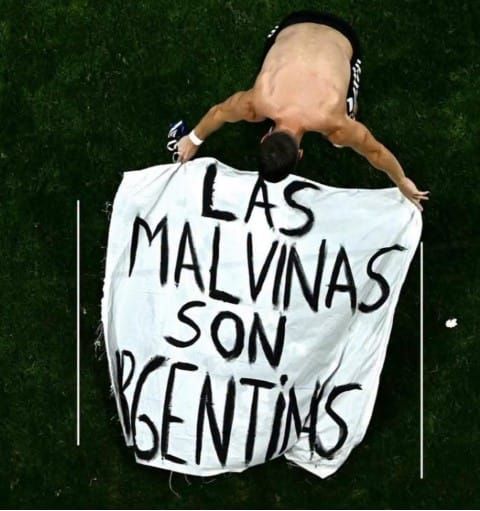
Following Argentina’s 2–1 victory over England in the World Cup semi-final played in Atlanta, a minority group of players from the national team displayed a banner reading “Las Malvinas son Argentinas” (“The Malvinas are Argentine,” using the Argentine name for the Falkland Islands). The incident took place once the match had concluded, during the celebrations, and in direct interaction with the crowd in the stands, from which the banner itself had come. The diplomatic reaction was immediate: British Prime Minister Keir Starmer backed calls for FIFA to investigate the episode, while Andrew Giuliani, head of the White House task force for the World Cup, defended the Argentine players by invoking the American commitment to free speech.
The case presents a notable legal problem: an expressive act performed by foreign athletes, on U.S. soil, inside a venue governed by the private regulatory regime of a Swiss association, once the sporting contest properly speaking had ended, and with the explicit political backing of the host State’s government. This paper argues that, although the First Amendment does not displace FIFA’s disciplinary authority, the temporal circumstance (once the competitive phase of the match had ended) and the nature of the act (a spontaneous interaction with spectators) justify a substantial mitigation of the punitive response. To that end, this article proposes understanding sports disciplinary jurisdiction as a power whose intensity varies according to the functional proximity of the act to the competitive core of the event.
Ultimately, it may be understood that every legal power exists to protect certain legally protected interests. When the connection between the conduct and those interests diminishes, the legitimate intensity of the sanctioning power should diminish as well.
Legal scholarship has long recognized the principle of proportionality as a limit on disciplinary power. This paper proposes a structural criterion for applying proportionality: the functional proximity between the conduct and the legal interest that justifies the disciplinary power. Accordingly, the scope of disciplinary control and the intensity of the punitive response must be graduated as that functional connection diminishes.
In these terms, as a thesis, this criterion may be formulated as a Variable-Intensity Principle: punitive rigor is graduated according to that functional connection.[1] Functional proximity is a more precise criterion than mere temporal proximity, because the interest protected by sports regulation is not the passage of time as such, but the preservation of the integrity of the competitive phenomenon.
I. The autonomy of the lex sportiva: FIFA as a private transnational legal order
FIFA is the paradigmatic example of what scholars call lex sportiva: a transnational normative order of private origin, with its own rule-making bodies (the Statutes, the Disciplinary Code, the Stadium Code of Conduct), its own enforcement bodies (the Disciplinary Committee, the Appeal Committee), and an arbitral jurisdiction of last resort (the Court of Arbitration for Sport, seated in Lausanne). This system operates with relative independence from state legal orders, and national courts—including American ones—have traditionally afforded it a wide margin of autonomy to regulate its internal affairs, provided that no rules of public policy or criminal provisions are violated.
The foundation of that autonomy is contractual: the Argentine Football Association and each of the players, upon entering the tournament, voluntarily agree to submit to FIFA’s Statutes and disciplinary regime. Article 11 of the Disciplinary Code sanctions conduct that brings football or FIFA into disrepute, and prohibits the use of a sporting event for manifestations of a non-sporting nature, including political messages. The Stadium Code of Conduct expressly forbids the display of banners, flags, or paraphernalia of a political character. Against this background, the sanction imposed on the AFA in 2014 (a fine of 30,000 Swiss francs for displaying a similar banner before the friendly against Slovenia) and UEFA’s sanctions against Spanish players for chants about Gibraltar during Euro celebrations illustrate the rigidity with which these private orders apply the principle of political neutrality.
That said, the fact that the lex sportiva is autonomous does not mean it is impermeable. Its legitimacy ultimately rests on its sanctions being proportionate and on its scope of application—material, personal and, as will be seen, temporal—being reasonably delimited.
II. The First Amendment and the state action doctrine: why the U.S. Constitution does not apply directly to FIFA, yet is not alien to it. A free contract or a contract of adhesion?
The White House’s backing, however eloquent in political terms, runs into a well-known technical obstacle in American constitutional law: the state action doctrine. The First Amendment protects individuals against censorship and expressive restrictions imposed by government—federal, state, or local—not against the rules of conduct that private organizations impose on their members. FIFA is a civil association governed by Swiss law; the World Cup is, legally speaking, its private event; and the players take part in it by virtue of a contractual bond presumed to be freely assumed. But is it truly “free,” or is it a contract of adhesion? In elite football, a player cannot negotiate the clauses of the FIFA Disciplinary Code if he wants to play in a World Cup: he either signs it in full or is left out of the highest competition of his profession. This element will reinforce why tribunals, such as the Court of Arbitration for Sport (CAS), should take it into account when applying the proportionality test, in order to prevent abuses of power, as will be seen below.
Under the settled case law of the Supreme Court of the United States, a private entity is subject to constitutional standards only when it performs a function that is traditionally and exclusively governmental, or when there is such entanglement with the State that its conduct can be attributed to it.
There is, however, a possible line of argument that deserves attention: a good number of World Cup stadiums—Atlanta’s Mercedes-Benz Stadium among them—receive public funding or belong to local authorities. Certain lines of case law on public forums and state-funded spaces make it possible to challenge absolute expressive restrictions in venues of that nature. This is not an argument with serious prospects of succeeding against a sports disciplinary sanction—the contractual framework remains decisive—but it is a datum that erodes the notion that the stadium is an entirely private space, beyond the reach of the host State’s legal order.
In short: the First Amendment does not “shield” the players from FIFA, but the analysis is not only whether the U.S. Constitution applies, but rather how far, in time and in subject matter, FIFA’s own jurisdiction extends.
III. The temporal limits of sporting jurisdiction: how long does an athlete remain subject to the tournament’s regulations?
The orthodox position in sports law holds that disciplinary jurisdiction is not extinguished by the final whistle: it reaches everything that occurs inside the venue before, during, and after the match, as long as the players remain on the field of play, in the mixed zones, or within official protocols. Post-match celebrations, on this reading, form part of the official event.
This position admits nuances that the Atlanta case puts to the test. It is one thing to assert that FIFA may exercise jurisdiction over what happens after the match, and quite another to maintain that the intensity of that jurisdiction is identical at every moment. Three distinctions are in order:
a) A temporal factor: Unlike the 2014 precedent, where the banner was displayed before kick-off, at the protocol moment of the official team photograph—at the very heart of the regulated event—here the act took place when the match had ended a considerable time earlier[2]. The contest, strictly speaking, was over; the result was final; the players’ competitive duties had been exhausted.
b) The origin of the object and the nature of the interaction: The banner was not introduced by the delegation as part of a planned staging: it came from the stands, and its display was the result of a spontaneous interaction between some players and the crowd. The act is not comparable to an institutional statement by the team, but rather to an expressive exchange between citizens—some on the pitch, others in the stands—at a moment when the competitive function was no longer being performed.
c) The minority character of the act: It was not the squad that posed institutionally behind the banner, but a minority of its members. This weakens the attribution of “team misconduct” and shifts the analysis towards individual acts of expression.
While these three factors do not eliminate FIFA’s jurisdiction—the incident occurred inside the venue and within the general framework of the event—they do degrade the intensity of the regulatory interest at stake: all three converge on a single datum, the act’s low functional proximity to the competitive core. And it is here that the host country’s legal order, even without applying directly, acquires interpretive relevance.
IV. Sporting neutrality and freedom of expression: a proportionality analysis once the competition has ended
Every sanctioning regime, even a private one, is subject to a proportionality test when it restricts expressive conduct: the restriction must pursue a legitimate aim, be suitable to achieve it, and not exceed what is necessary. The aim of FIFA’s neutrality rule is legitimate and understandable: to prevent the competition from becoming a stage for political and diplomatic disputes, to protect the integrity of the spectacle, and to prevent hostile reactions between fan bases[3].
But the force of that aim is not constant over time. It reaches its maximum intensity during the competition and in the protocol acts that frame it, and declines markedly once the match has ended and the players interact freely with the crowd. In that residual moment, FIFA’s interest in neutrality coexists with—and must be weighed against—a countervailing interest of considerable weight: the freedom of expression of persons physically present in the territory of a State whose Constitution enshrines that freedom with exceptional breadth, and whose own government, through the presidential task force for the World Cup, has stated that the act falls within the exercise of free speech.
The host State’s legal framework, while not a directly applicable rule, should be taken into account as a mitigating criterion: an element of the normative context that the disciplinary body ought to consider when calibrating the sanction. To punish with identical rigor a planned political statement at the pre-match protocol ceremony and a spontaneous, minority, post-competitive gesture arising from interaction with the stands on American soil would amount to treating alike what is substantially different, in violation of the principle of proportionality that CAS case law itself recognizes as a limit on sports disciplinary power[4].
Functional proximity is not a merely chronological criterion. An act may take place after the match and nonetheless remain integrated into the competitive core (as occurs during the official award ceremony), while another may occur just minutes later and already lie in the functional periphery of the event. What is decisive is not the time elapsed, but the connection the conduct maintains with the purposes that justify FIFA’s disciplinary authority.
From this perspective, the outcome most consistent with precedent and with the balancing proposed here would be a moderate financial sanction against the AFA—in light of the foregoing, even more attenuated than the 2014 fine—ruling out player suspensions, which would be disproportionate to the nature of the act and particularly burdensome on the eve of the final against Spain.
Conclusion
The Malvinas banner case in Atlanta does not demonstrate the supremacy of the First Amendment over FIFA, nor does it distort the state action doctrine or the contractual consent of the participants. But it does expose a scarcely explored area of transnational sports law: the zone of friction between the constitutional rights in force in the host State and the autonomy of the lex sportiva, which becomes especially visible at the temporal margins of the tournament’s jurisdiction.
When the expressive act is spontaneous, carried out by a minority, subsequent to the conclusion of the match, and born of interaction with the crowd—when the athlete has ceased to perform his competitive function and acts as an individual communicating with others—the regulatory interest in neutrality weakens, and the host country’s expressive standard demands, at the very least, a mitigating role in the calibration of the disciplinary response. That entire reasoning rests on the idea of jurisdiction as a power of variable intensity. FIFA retains the final word within its legal order; but the legitimacy of that word will depend on its recognizing that not everything that happens inside the stadium happens, with the same intensity, inside the tournament.
Note: this draft constitutes academic analysis, not legal advice. The passages concerning the likely disciplinary outcome are estimates based on precedent.
[1] While the present article proposes, as far as could be verified, an original doctrinal distinction concerning the variable intensity of disciplinary jurisdiction, it builds upon a broader body of scholarship describing lex sportiva as an autonomous transnational legal order operating within a pluralistic legal environment. See, e.g., Lorenzo Casini, The Making of Lex Sportiva by the Court of Arbitration for Sport, 12 German Law Journal 1317 (2011); Antoine Duval, Lex Sportiva: A Playground for Transnational Law (European Law Journal, 2013); and Paul Schiff Berman, Global Legal Pluralism (Cambridge University Press, 2012). None of these works formulates the criterion of "functional proximity" or conceives disciplinary jurisdiction as a power of variable intensity; rather, they provide the theoretical framework within which the present proposal is situated. The functional proximity criterion does not challenge the autonomy of lex sportiva described by Duval or Berman; rather, it provides an internal criterion for calibrating the legitimate exercise of disciplinary authority within that autonomous legal order.
[2] The distinction between the competitive core of the event and its post-match periphery is put forward here as a doctrinal construction: no CAS award has been identified, as far as could be verified, that formulates it in these terms. Its foundation lies in the general principle of proportionality, consistently recognized by sports arbitral case law as a limit on disciplinary power, which requires that sanctions be graduated according to the culpability of the agent and the concrete circumstances of the act: premeditation in a protocol setting cannot receive the same treatment as reactive or spontaneous conduct arising from interaction with the crowd once the match has ended.
[3] A conceptual clarification: a distinction must be drawn between strict liability and individual culpability. In the disciplinary law of FIFA (and of UEFA), strict liability applies almost absolutely to clubs and federations for the acts of their supporters (Art. 16 of the FIFA Disciplinary Code): if the crowd displays a prohibited banner, the federation is automatically held responsible, regardless of its fault or its efforts to prevent it. An illustrative example is CAS 2017/A/5306, Guangzhou Evergrande Taobao FC v. Asian Football Confederation (award of 15 January 2018), in which the club was sanctioned for an offensive banner displayed by its own spectators towards the end of the match. By contrast, when an individual athlete is judged, the standard shifts to liability based on culpability or intent; it is there that the temporal and spatial context of the act operates as a mitigating factor.
[4] CAS panels commonly adopt the standards of international human rights tribunals as an interpretive reference. Thus, in CAS 2014/A/3516, Yerolimpos v. World Karate Federation, the panel examined a disciplinary sanction for expressive conduct by reference to the European Convention on Human Rights, describing its standard as indicative and, in the jurisdictions where it applies, compulsive. It should be noted that in that case the sanction was ultimately upheld, as the communications at issue were defamatory and lacked evidentiary support; the value of the precedent lies not in its outcome but in its method: sports disciplinary bodies do not hold a blank check to restrict expression, and their sanctions must withstand scrutiny informed by human rights standards and by the principle of proportionality.