The States v. Meta: The Thin Moral and Legal Line of Algorithmic Design

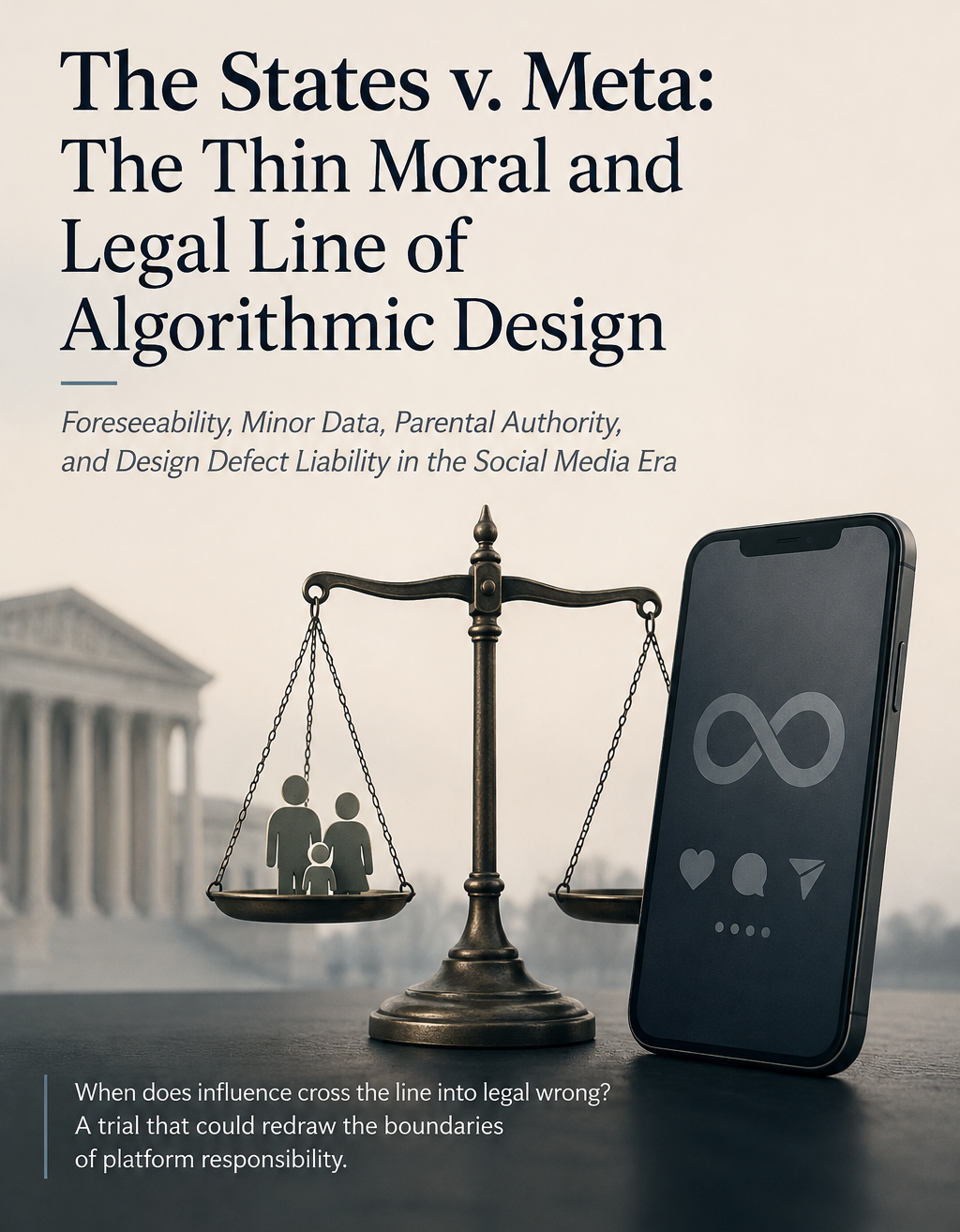
Foreseeability, Minor Data, Parental Authority, and Design Defect Liability in Social Media
The question no longer is whether social media platforms shape their users. Of course they do; that is what they are built to do. The question is where influence stops being a lawful commercial outcome and becomes an actionable source of harm.
I want to propose a single line for tracing that boundary, and then test it against what is actually happening in an Oakland courtroom this month:
Influence → Foreseeability → Knowledge → Design Choice → Avoidability → Liability
Each arrow is a threshold, and liability attaches only when all five have been crossed. Influence alone is not tortious. Foreseeable influence is not tortious either. What converts architecture into a legal wrong is the conjunction: the risk was visible, it was repeated, it was documented internally, a reasonable alternative was technically and economically available — and the firm kept the design anyway because it maximized engagement.
That is the claim. The interesting part is that the trial now underway may not resolve it, and the cases the plaintiffs have already won suggest the doctrine is arriving by a different road than the one everybody expected.
What Is Actually on Trial
Precision matters here, because the case is routinely described in ways that flatten it.
This is a bipartisan coalition of state attorneys general in federal court in Oakland, within the multidistrict litigation consolidated as In re: Social Media Adolescent Addiction/Personal Injury Products Liability Litigation (N.D. Cal., MDL No. 3047), before Chief Judge Yvonne Gonzalez Rogers.
The claims are split. Four states (California, Colorado, Kentucky and New Jersey) are leading the allegations that Meta engineered Facebook and Instagram to be addictive to minors and misled consumers about their safety. The claim brought by the 29-state coalition in this trial is narrower: that Meta unlawfully collected and used the data of children under 13 in violation of federal law. The remaining twenty-five states go to trial later.
The jury is advisory. An eight-person jury has been empaneled expressly in an advisory capacity. It will answer specific questions. Judge Gonzalez Rogers decides the case. Trial is expected to run roughly seven weeks, with a ruling anticipated around October.
The numbers are contested by two orders of magnitude. Meta has said exposure could reach $1.4 trillion, near its own market capitalization. The attorneys general have suggested something closer to $200 billion. Beyond money, the states are asking the court to order age restrictions and the elimination of features such as infinite scroll — nationwide.
That last point is the one to watch. An injunction rewriting the architecture of a platform for every user in the country is a different kind of remedy than a damages award, and it is where the constitutional objections will be sharpest.
Content Versus Architecture and Why the Split Is Messier Than Advertised
The plaintiffs' strategic move is now familiar: do not sue over what users post, sue over how the product is built. Infinite scroll, push notifications, autoplay, algorithmic reward loops — these are framed not as speech but as engineered features, assessable under product liability's design defect standard.
The purpose is to route around Section 230 of the Communications Decency Act, which for two decades has immunized platforms as publishers of third-party content.
It is tempting to say the shield has been bypassed. That overstates the record, and the overstatement matters.
In November 2023, Judge Gonzalez Rogers granted in part and denied in part the motions to dismiss (In re Social Media Adolescent Addiction, 702 F. Supp. 3d 809). Section 230 immunity applied to some of the design defect claims and not to others. Failure-to-warn claims survived. Negligence per se survived. And the design defects that survived are not the ones usually cited in the press: the court's reasoning turned on whether an alleged defect could be fixed without altering the publication of third-party content. What passed that filter were the peripheral, non-expressive features — the absence of effective parental controls and notification, the absence of self-imposed time limits, the friction deliberately built into account deletion, deficient age verification, reporting protocols.
Note what that means for the standard narrative. The features most often described as the smoking gun (infinite scroll, the algorithmic feed, the like counter) are precisely the ones most entangled with content curation, and therefore the most exposed to Section 230 and First Amendment defenses. The features that cleared the threshold are the mundane ones nobody writes headlines about.
This month's Ninth Circuit ruling, which allowed thousands of these suits to proceed to trial, settled sequencing rather than substance: the appellate court did not hold that Section 230 fails to reach design claims. Gonzalez Rogers had already cleared the states for trial on July 1, 2026, finding genuine disputes of material fact over addiction and targeting.
So the honest formulation is not the shield has fallen. It is: a partial breach has opened, its width is unsettled, and the doctrinal question of whether an engagement algorithm is a product or a publication remains genuinely open.
The Neurobiology: What the Science Supports (and What It Does Not)
Foreseeability depends on what a reasonable manufacturer should have anticipated about its audience. So the developmental question is unavoidable — but it has to be stated carefully, because the loose version is a liability.
The common formulation (that the prefrontal cortex is "not fully developed until 25" and therefore adolescents cannot resist) is a caricature that developmental neuroscientists have been walking back for years. Maturation is not a switch, the age figure is an artifact of where researchers stopped scanning, and executive function largely stabilizes in late adolescence.
The better-supported framing is the dual-systems account associated with Steinberg and with Casey and colleagues: adolescence involves a temporal mismatch between an early-maturing reward and salience system and a later-maturing cognitive control system. The result is not incapacity but asymmetry — heightened reward sensitivity running ahead of the regulatory machinery, particularly under conditions of social evaluation and peer presence.
That asymmetry is legally sufficient, and it is more defensible than the caricature. It also maps precisely onto the design. Intermittent variable reinforcement (the Skinner-box schedule that powers slot machines) is effective exactly because reward timing is unpredictable. Will there be a like, a comment, a view spike? Persuasive technology, in the tradition of Fogg's captology, is the deliberate engineering of behavior through that mechanism.
When an unpredictable social-reward schedule is deployed against a population whose reward sensitivity structurally outpaces its inhibitory control, the platform is not offering a neutral venue. It is trading on a known asymmetry. Upward social comparison, fear of missing out, and displaced sleep are not surprises. They are the predicted output of an environment optimized for retention.
Maybe the narrower claim is the stronger one: not that adolescents cannot choose, but that the design was calibrated to a period of maximal reward sensitivity, and the calibration was intentional.
The RAD Dilemma: Design Defect or Categorical Liability?
Under the Restatement (Third) of Torts: Products Liability § 2(b), establishing a design defect hinges on proving the existence of a Reasonable Alternative Design (RAD)—a feasible, economically viable modification that would have meaningfully mitigated the harm.
In engineering terms, the plaintiffs’ proposed interventions are strikingly modest. They do not demand a rewrite of the web: they ask for infinite scroll to be disabled by default on minor accounts, overnight push notifications to be suppressed, public approval metrics to be hidden, age verification to be enforced, and account deletion to be as frictionless as onboarding.
Yet, this argument faces the strongest defense available under product liability doctrine: the categorical liability objection. If stripping away engagement mechanisms alters the fundamental nature of the service, the plaintiffs are no longer arguing that the product could have been built more safely, they are asserting that the product should not exist at all. Courts have consistently held that RAD is not satisfied by proposing that a defendant sell a different product altogether. Meta will inevitably argue that an engagement platform stripped of engagement optimization is precisely that.
This defense, however, encounters two major friction points, one rooted in choice architecture, the other in Meta’s own history.
First, the issue is not feature elimination, but default settings. Toggling infinite scroll to "off" by default or establishing a notification curfew for adolescents does not erase these functionalities; it merely shifts the burden of initiation onto the user. Because choice architecture defaults represent the lowest-friction, highest-impact safety interventions in digital engineering, their deliberate omission is deeply probative of negligence.
Second, the defense’s claim of impossibility is undermined by Meta's own product timeline. Facebook and Instagram functioned for years without infinite scroll; Meta even conducted documented, large-scale experiments removing public like counts before choosing to restore them. A design state that the defendant itself once successfully ran in production can hardly be dismissed as an unviable "different product."
Where the categorical objection poses a genuine challenge is in the core ranking algorithm itself. It is at that precise intersection (where algorithmic recommendation overlaps with content prioritization) that "reasonable alternative design" bleeds into "editorial judgment," bringing Section 230 immunity and First Amendment protections right back into the courtroom.
Knowledge: State It Precisely or Lose the Paragraph
The step from foreseeability to actual knowledge is what elevates negligence into something closer to conscious disregard. It is carried by the internal documents.
But the most-quoted figure is almost always mis-stated, and the mis-statement is costly. The widely circulated version (that Instagram worsened body image for one in three teenage girls) is not what the internal research said. The slide reported that among teenage girls who already felt badly about their bodies, roughly thirty-two percent said Instagram made it worse. That is a conditional finding within an already-affected subgroup, not a population-level effect.
Meta has litigated that distinction relentlessly, and it is right to. Anyone writing about this case who uses the loose version hands the defense a free demonstration that the plaintiffs' side is not reading carefully.
The precise version is still damning, and it is damning for the right reason. What matters legally is not the effect size. It is that the company commissioned the research, received the result, and did not act on it. Internal knowledge of a risk within an identifiable vulnerable subgroup, followed by continued deployment of the same design, is the classic fact pattern of conscious disregard. The number does not have to be large. It has to have been known.
This also explains a strategic migration that is easy to miss. The epidemiological literature is weaker than advocates claim. Twenge and Campbell's 2018 screen-time findings were substantially undercut by Orben and Przybylski's specification-curve analysis, which found the association between digital technology use and adolescent well-being to be vanishingly small — comparable, in their well-known comparison, to entirely mundane variables. Meta will put that literature in front of the court.
Which is precisely why the plaintiffs' case now rests less on population epidemiology and more on documents. When general causation is contested, internal knowledge does the work that the science cannot. That is not a weakness of the case. It is an adaptation to one.
The Moral Side
Legal responsibility and moral responsibility are not coextensive, and the gap runs in both directions.
A platform may escape liability for effects it genuinely caused because causation is diffuse, because the plaintiff cannot isolate it from family, school, genetics, and poverty, because the doctrine was not written for this. Escaping liability is not the same as being blameless. The designers of a system are not morally neutral with respect to the architecture they choose, and the absence of a statute prohibiting a specific interface pattern does not make the pattern innocent.
The reverse also holds. Liability can attach where moral fault is thin, a diffuse corporate process in which no individual made a culpable choice, and the harmful configuration emerged from thousands of A/B tests, each locally rational.
That second case is the harder one, and it is where the continuum earns its keep. Each of its five thresholds is an institutional fact, not a mental state. Was the risk foreseeable? Was it known — meaning: did the information reach a place in the organization where someone could act? Was there a choice? Was there an alternative? None of these require identifying a villain. They require reconstructing what the organization knew, when, and what it did next.
That reframing has a consequence I will return to at the end: the continuum is only as operable as the record permits. Every one of those five thresholds is a question about traceability.
The Positions in the Room
To understand the trial's complexity, let's examine the primary legal and strategic positions that I think each party could take.
1. The individual plaintiffs. Meta monetized adolescent psychological vulnerability as a commercial asset. Under the pressure of the attention economy, retention was prioritized over safety and internal warnings were absorbed rather than acted upon.
2. The state attorneys general — liability by continuity. Intent to harm is unnecessary. It suffices that the risk was known, persistent, and technically remediable, and that operations continued without adequate safeguards. Their claims are also, importantly, consumer protection and data claims — not only tort.
3. Meta's defense. Three pillars, and the order in which they are usually listed is wrong.
The strongest is not parental authority. It is definitional: Meta argues it could not have deceived consumers about addictiveness because "social media addiction" is not a recognized psychiatric condition. There is no such diagnosis in the DSM-5-TR or the ICD-11, gaming disorder is recognized, social media addiction is not. If the condition does not formally exist, the argument runs, there was no established fact to conceal.
This attacks my own threshold test at its weakest joint. My criterion requires the risk to be scientifically documented. Meta's answer is that it is scientifically contested, which is a different thing, and closer to the truth.
The answer, I think, is that the threshold does not require nosological recognition. It requires documented harm. Compulsive use patterns, sleep displacement, and distress in identified subgroups were measured (by Meta) regardless of whether a diagnostic manual has named the syndrome. Tort law has never waited for the DSM. It did not wait for a formal diagnosis to impose liability for asbestos or tobacco.
The second pillar is multifactorial causation: adolescent mental health is shaped by genetics, family, economics, and schooling, and isolating one application as proximate cause is legally unsound. This is the strongest empirical argument the defense has, and the Orben-Przybylski line of research supports it.
The third is parental authority. Meta emphasizes a minimum age of thirteen, supervision tools, and the parents' role as ultimate guardians of their children's digital life. In United States law this is assumption of risk and comparative fault.
And this pillar contains its own defeat. Assumption of risk requires knowledge of the risk. A parent cannot knowingly assume a danger the manufacturer was concurrently concealing. Meta cannot simultaneously argue that parents consented to a known risk and that the risk was not established. The concealment claim and the consent defense are mutually corrosive, and the plaintiffs should be pressing exactly there.
There is a related point on the data claims: the federal children's privacy statute has no private right of action. The states proceed parens patriae. That is not a technicality: it is why the data claim is carried by the 29-state coalition rather than by families.
4. The court. Novel technology does not suspend ordinary duties of care; it changes what diligence requires. The judge must decide whether parental consent can neutralize liability for a product engineered to operate below deliberate choice, and whether the supervision tools offered to parents are genuine safeguards or liability shields.
5. The advisory jury (its status is the most interesting thing in the room). The eight jurors will answer questions; the judge will decide. This is an unusual and revealing arrangement. The lay conscience of the community is consulted on whether an engagement feature crossed from ordinary commerce into unreasonable danger, and then a professional judge determines what follows.
That is not a procedural footnote. It is a small institutional experiment in exactly the problem this litigation poses: when the object of judgment is an optimization system that no individual designed in full, who is competent to judge it? The advisory-jury structure answers, tentatively, neither alone.
What the Record Actually Shows: Nuisance Is Outrunning Design Defect
Here is the finding that ought to unsettle anyone building a theory on the RAD, including me…
The plaintiffs' significant victories so far have not come through design defect. In New Mexico, a jury in March 2026 found roughly 75,000 violations of the state's Unfair Practices Act and imposed the maximum civil penalty ($375 million). In August, Judge Bryan Biedscheid of the Santa Fe County District Court held that the conduct also constituted a public nuisance, and ordered $567 million into an abatement fund, the bulk of it for treatment services, the remainder for prevention, screening, and coordination over five years. The court declined to shut the platforms down and ordered harm reduction instead. Meta will appeal.
Both winning theories (consumer protection and public nuisance) bypass the RAD requirement entirely. Neither asks whether a safer alternative design existed. The first asks whether the company said false things. The second asks whether the activity imposes unreasonable costs on a community, and issues an abatement order rather than compensating a plaintiff.
Similarly, the March 2026 California verdict that found Meta and Google liable for one plaintiff's mental distress produced $3 million; a real precedent, but not the kind of number that changes an industry.
So the doctrinal picture is this. Design defect is the intellectually cleanest theory and the least successful one. Nuisance is doctrinally messy, historically disfavored in products contexts, and it is winning.
Why? Because the RAD requirement asks a question about counterfactual engineering that courts find genuinely hard to adjudicate for attention products, while nuisance asks a question about aggregate social cost that requires no counterfactual at all. Nuisance also delivers the remedy the states actually want: not damages, but an abatement order that changes the product.
This does not defeat the continuum. It relocates it. Foreseeability, knowledge, choice, and avoidability are doing exactly the same work inside a nuisance analysis — they are what makes the interference unreasonable. The continuum survives the change of doctrinal vehicle. But anyone claiming that this litigation is a product liability revolution should notice that the wins are arriving under a different heading.
The Fiction Precedent: The Defense That Convicts Itself
(Alert Spoilers for Black Mirror, "Smithereens")
A grieving man takes a company employee hostage and demands to speak to “Billy”, founder of the world's largest social network. Billy tells him the platform began as a way to connect people. Then it grew, and the company hired behavioral psychologists and dopamine specialists, and made the thing as compulsive as a casino in your pocket. And now, Billy confesses, he does not control it. The machine runs itself.
Suppose Meta made that argument in court. Suppose it said: the ranking system is an emergent optimization process; no one designed these effects; we cannot fully explain or steer it…
Tort law has a long-settled answer to the operator of an instrumentality who pleads inability to control it: the inability is the negligence. You do not escape liability by demonstrating that you built something you could not govern. That is the case for liability, not against it — and in the strict-liability tradition it is close to the paradigm.
The degree of reprehensibility regarding due diligence is certainly not the same in 2006 as it was in 2016, and more in 2026...
But notice what the "loss of control" plea actually asserts. It is an epistemic claim: we cannot reconstruct why the system did what it did. And that claim is exactly what my five thresholds cannot survive.
Foreseeability is a question about what was knowable. Knowledge is a question about what was recorded and where it went. Design choice is a question about what alternatives were evaluated and by whom. Avoidability is a question about what was measured and what was ignored. Every threshold on the continuum is a question that only a record can answer.
Which means the entire structure of design liability for algorithmic systems rests on something that is currently optional: whether the system keeps a log adequate to reconstruct its own decisions, and whether that log is available to anyone other than the firm that wrote it.
In this case, it happened to be available. Meta's internal research existed, was written down, and was disclosed — through whistleblowers, through discovery, through congressional testimony. The plaintiffs can prove knowledge because the knowledge was documented. That is contingent. It is not a property of algorithmic systems; it is an accident of this particular corporate culture and this particular era of litigation.
The next generation of these systems will not necessarily produce that record. A model whose relevant decisions are distributed across weights rather than memos generates no slide deck to leak. And a firm that has watched this trial has every incentive to ensure the next system's reasoning is not reconstructible.
This is the point at which private tort litigation reaches its limit and something else has to take over. Case-by-case adjudication can allocate losses after the fact. It cannot guarantee that the evidentiary substrate for adjudication will exist at all. That guarantee is architectural, and it has to be constitutive rather than remedial — a traceability and contestability requirement imposed as a condition of deployment, verified by a third party independent of both the developer and the state, not reconstructed afterwards by whichever litigant is lucky enough to find a whistleblower.
That is not a "human in the loop." It is a structural third: the institutional position that makes review possible at all. Without it, the continuum from influence to liability is not a legal test. It is a hope that someone kept the notes.
Final Reflection
Foreseeability is the bridge between knowing a risk and having a duty to act on it. If harm is reasonably anticipable, if viable alternatives exist, and if a firm sustains an engagement-first architecture in the face of accumulating evidence, the conduct can be negligent whether or not any statute named the specific code.
So the question is not whether algorithms cause harm. Algorithms do things; that is what they are. The question is whether harm was built into a design whose risks were knowable, whose alternatives were feasible, and whose continuation was a corporate choice.
Judge Gonzalez Rogers will answer some of that in October. But the more consequential question sits underneath the one being tried, and no verdict in Oakland will settle it: whether we will require these systems to keep a record adequate to the judgments we intend to make about them, before we need it, rather than after.
Foreseeability has always been a function of what could be known. For algorithmic systems, what can be known is a design decision. Which means foreseeability itself is now something a company builds, or declines to build.
References and Legal Citations
Cases and proceedings
- In re Social Media Adolescent Addiction/Personal Injury Products Liability Litigation, MDL No. 3047, 702 F. Supp. 3d 809 (N.D. Cal. 2023) (order on motions to dismiss, Nov. 14, 2023; Section 230 and First Amendment analysis of design defect, failure-to-warn, and negligence per se claims).
- In re Social Media Adolescent Addiction — summary judgment order clearing state attorneys general claims for trial, July 1, 2026 (N.D. Cal.).
- Ninth Circuit ruling permitting thousands of consolidated addiction suits to proceed to trial, August 2026.
- New Mexico ex rel. Torrez v. Meta Platforms, Inc. (First Judicial District Court, Santa Fe County) — March 2026 jury finding of ~75,000 Unfair Practices Act violations, $375M civil penalty; August 2026 public nuisance ruling and $567M abatement order (Biedscheid, J.).
- California JCCP bellwether verdict, March 2026 (Meta and Google found liable; $3M award).
Statutes and restatements
- Restatement (Third) of Torts: Products Liability § 2(b) (design defect; Reasonable Alternative Design).
- Communications Decency Act of 1996, 47 U.S.C. § 230.
- Children's Online Privacy Protection Act, 15 U.S.C. §§ 6501–6506 (no private right of action; state enforcement parens patriae).
Adolescent development
- Casey, B. J., Jones, R. M., & Hare, T. A. "The Adolescent Brain." Annals of the New York Academy of Sciences, vol. 1124 (2008).
- Steinberg, L. "A Social Neuroscience Perspective on Adolescent Risk-Taking." Developmental Review, vol. 28, no. 1 (2008).
- Blakemore, S.-J., & Choudhury, S. "Development of the Adolescent Brain: Implications for Executive Function and Social Cognition." Journal of Child Psychology and Psychiatry, vol. 47, nos. 3–4 (2006).
Screen time and well-being — and the rebuttal
- Twenge, J. M., & Campbell, W. K. "Associations Between Screen Time and Lower Psychological Well-Being Among Children and Adolescents." Preventive Medicine Reports, vol. 12 (2018).
- Orben, A., & Przybylski, A. K. "The Association Between Adolescent Well-Being and Digital Technology Use." Nature Human Behaviour, vol. 3 (2019) (specification curve analysis; substantially smaller effects than previously reported).
Persuasive design
- Fogg, B. J. Persuasive Technology: Using Computers to Change What We Think and Do. Morgan Kaufmann / Stanford Persuasive Technology Lab.
Products liability commentary
- "Product Liability's Parallel Universe: Fault-Based Liability Theories and Modern Products Liability Law." Brooklyn Law Review, vol. 74.
- "Unmasking the Test for Design Defect: From Negligence to Strict Liability to Negligence." Vanderbilt Law Review, vol. 33.
Contemporaneous reporting
- Reuters, "Meta, 29 states head to court in biggest test yet of youth social media litigation," Aug. 12, 2026.
- Reuters, "Meta rejects claims it sought to hook children to Facebook, Instagram," Aug. 18, 2026.
- Associated Press / NPR, "Court orders Instagram and Facebook's Meta to pay $567M to address kids' mental health online," Aug. 7, 2026.
- Al Jazeera, "Landmark trial on Meta's impact on children's mental health begins in US," Aug. 18, 2026.