An apology for profitable enterprises as a civilizational foundation

By Gastón Rey
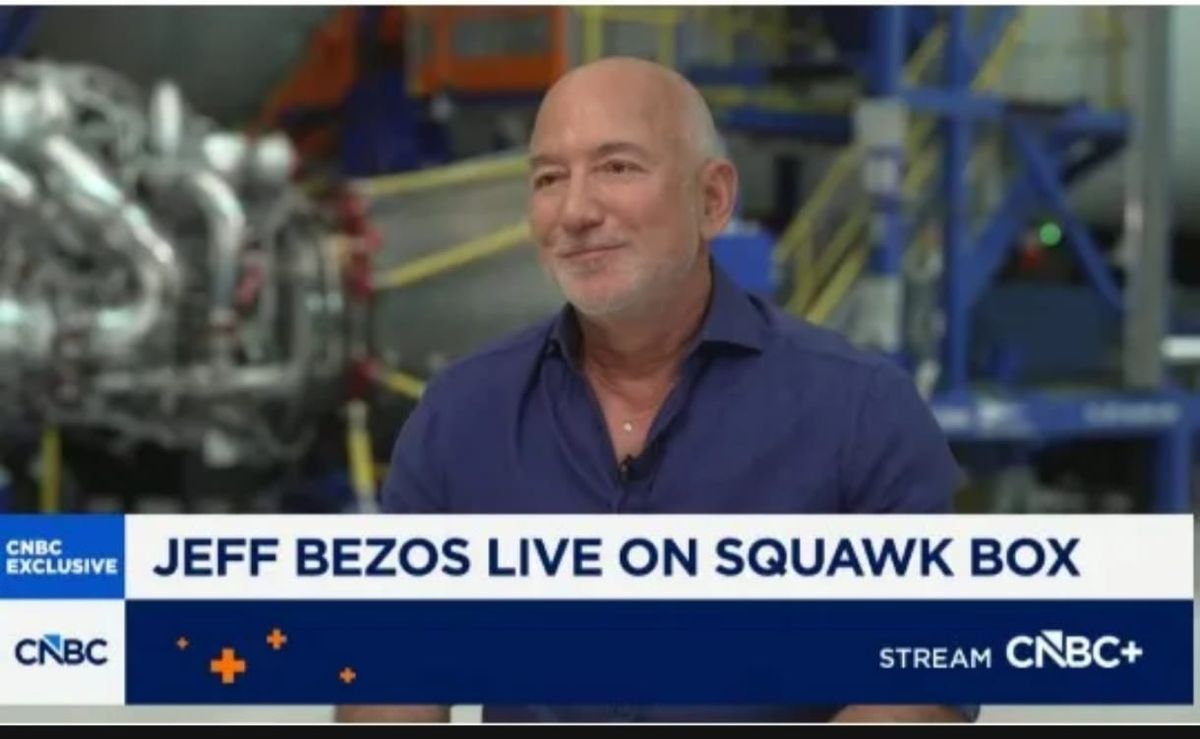
“You could double the taxes I pay, and it’s not gonna help that teacher in Queens.”
Jeff Bezos, CNBC, May 2026
Abstract
This essay defends scalable productive coordination as the primary engine of civilizational prosperity against redistributive and zero-sum conceptions of wealth. Using the controversy surrounding Jeff Bezos’s public defense of entrepreneurial production and tax reform as a point of departure, the paper argues that modern prosperity emerges from dynamic competition, capital accumulation, innovation, and institutional openness rather than from redistribution itself.
The analysis challenges contemporary narratives of “exploitation” by distinguishing between ordinary competitive bargaining, genuine coercive abuses, and monopsonistic distortions generated by barriers to market entry and labor mobility. Drawing on marginalist economics, subjective value theory, public-choice theory, and the literature on rent-seeking, the essay argues that many forms of durable economic domination are better understood as products of state-backed exclusion than as intrinsic features of market exchange.
The paper further examines the relationship between scalable production, technological innovation, and contestable competition, defending the view that productive enterprises capable of reducing structural transaction costs generate long-term social gains that redistribution alone cannot reproduce. While acknowledging the reality of labor abuse, cronyism, and regulatory capture, the essay contends that these phenomena represent deviations from competitive market processes rather than their defining logic.
Ultimately, the essay argues that redistribution may mitigate hardship at the margins, but civilization-scale prosperity depends fundamentally on scalable systems of production, innovation, and open competition.
Key words: Scalable production -Contestable competition - Subjective theory of value - Monopsony - Rent-seeking - Creative destruction - Public choice theory -Wealth creation - Regulatory capture - Political economy of technology.
In a recent CNBC interview with Andrew Ross Sorkin, Jeff Bezos ignited a familiar firestorm. By arguing that building sustainable, profitable enterprises does more for human civilization than direct charitable giving (and by proposing that the bottom half of U.S. earners pay zero federal income tax) he challenged the bedrock tenets of modern progressive sentiment. The backlash was swift, resurrecting a predictable litany of criticisms: systemic labor exploitation, calls for heavier taxation of the wealthy, and the charge of monopolistic market dominance.
Before defending him, let me state my method plainly, because it is what separates this essay from the usual partisan reflex: I will concede everything that is true in the critique, and then show why none of it proves what the critics believe it proves.
Cronyism is real. Workplace abuse is real. Illegal labor practices, coercive arrangements, and predatory corporate behavior are real. Human beings frequently misuse positions of power, including within economic organizations. What is not real is the theory that these phenomena constitute the engine of wealth creation, or that they are intrinsic features of voluntary exchange itself. The critics have correctly identified several pathologies, but they have systematically misidentified their causes.
I. The pillars: why the pie is not fixed
Bezos’s worldview rests on three claims that are, properly understood, simply mainstream economics.
The zero-sum fallacy. Dynamic capitalism operates on wealth expansion, not fixed allocation. Amazon did not capture a slice of an existing market; it built an ecosystem — millions of jobs, millions of third-party sellers, and an infrastructure that systematically lowers transaction costs and raises real living standards. This is not ideology; it is the single most replicated fact in economic history. Real GDP per capita was nearly flat for millennia and then turned vertical with the Industrial Revolution: the “hockey stick” documented by the Maddison Project on long-run output. The pie demonstrably grows.
The deeper point is cultural, and Bezos is fighting an opponent older than Marx. Zero-sum intuition is the human cognitive default: our ancestral environment really was near zero-sum (fixed land, fixed game, one tribe’s gain was another’s loss), and the instinct never left us. It was perfectly rational for a feudal lord — the dogma Montaigne captured in 1580, that the profit of one is the damage of another — but the world it described no longer exists. Recent empirical work by Sapienza, Stantcheva and co-authors (“Zero-Sum Thinking and the Roots of Political Divides,” QJE, 2024) shows the zero-sum mindset is measurable, transcultural, and a strong predictor of redistributive politics. This is why the message that “Bezos’s billions did not come out of your pocket” feels false to so many people. It contradicts a hardwired heuristic. The task of economics (and of this essay) is to correct the instinct with the evidence.
Production scales; charity transfers. Immediate charity addresses transactional scarcity — it feeds a population for a day. Building an ultra-efficient logistics matrix permanently lowers the structural cost of distributing food and goods for millions, across generations. Both are good. Only one compounds.
Autonomy over dependency. Sustainable employment is an engine of individual self-determination. Permanent philanthropic and welfare-bureaucratic dependency, by contrast, tends to crowd out the incentives for mobility it claims to serve.
II. The proposal and the objection it should raise
Bezos’s concrete proposal is politically ingenious: eliminate federal income tax for the bottom 50% of earners. The bottom half currently supplies only about 3% of federal income-tax revenue, while the top 1% supplies roughly 40%. “I don’t want to reduce it, I want to eliminate it,” Bezos said. The rhetorical force is real: as he put it, zero is a far more powerful number than a small dollar amount. A nurse in Queens earning $75,000 should not be wiring $12,000 to Washington; the state, he quipped, owes her an apology.
I want to be clear here, because the strongest objection to this proposal comes not from the left but from within the classical-liberal tradition itself. The public-choice school (Buchanan, Tullock) warns that severing the link between a citizen and the cost of government is dangerous: people who pay nothing for the state have no fiscal reason to restrain it. A permanently exempt majority is, in principle, a machine for expanding the Leviathan — the median voter can always vote to spend other people’s money. Moreover, the proposal redistributes who pays without shrinking what the state spends.
So the proposal should be defended for what it is: a necessary first move, not the destination. It is right because the income tax on subsistence-level work is morally indefensible and economically trivial to forgo. But it is incomplete unless paired with genuine fiscal discipline. To present it as a clean victory would ignore the very public-choice logic that makes the rest of this essay coherent.
III. The exploitation myth: refuting the live argument, not the dead one
The standard critique of Bezos’s fortune descends from the Marxist Labor Theory of Value (LTV): wealth is “surplus value” extracted from labor, so profit is theft by definition. Marginalism (Menger, Jevons, Walras) buried this in the 1870s. But it is worth being precise, because imprecision here is exactly where critics counterattack.
The subjective theory of value does not claim that labor is irrelevant to price. Labor is obviously a cost and obviously affects supply. The claim is about causal direction. In Menger’s theory of imputation, value originates in the consumer’s valuation of the final good and is then imputed backward onto the factors that produce it, including labor. Value flows from consumer to factor, not from labor to value. Labor enters the price as a derived magnitude, never as its source or measure. Marx ran the arrow the wrong way. Böhm-Bawerk’s Karl Marx and the Close of His System (1896) demonstrated this internally, and Marx’s own unfinished “transformation problem” (converting labor values into observed prices in Volume III of Capital) was never solved by him or his successors. The LTV is not merely outdated; it is internally incoherent.
Here is the part most pro-market essays miss: no serious critic in 2026 actually defends the LTV. The live academic argument for “exploitation” is monopsony. The claim, associated with the empirical labor economics of Card and Krueger (Myth and Measurement, 1995) and its successors, that where employers have labor-market power, wages can sit below a worker’s marginal product. This is a real phenomenon and deserves a real answer, not a wave of the hand.
The answer turns on a distinction the word “exploitation” deliberately blurs. The mere fact that an employer seeks to pay the lowest wage compatible with retaining labor is not, by itself, exploitation. It is structurally analogous to the worker seeking the highest possible wage, or the consumer seeking the lowest possible price. All three reflect the same underlying logic of voluntary exchange under conditions of scarcity: each participant attempts to maximize subjective advantage within the constraints of competition. This is the normal case: symmetry, not pathology.
Monopsony is the exception to that symmetry, not its refutation. It arises precisely when one side’s bargaining position stops being checked by the other — when the worker cannot credibly walk away. And that asymmetry is contingent, not structural: it depends on barriers to worker mobility and to employer entry, many of which (occupational licensing, non-competes, zoning that restricts where firms and workers can locate) are themselves state-created. Where exit is open, competition is the cure: a firm paying below productivity creates a clean profit opportunity for a rival to enter, bid the worker away, and capture the margin. This is also where the argument earns its falsifiability: the market would indeed stand convicted if abuse persisted systematically under conditions of open competition and free exit. It does not. The abusive employer loses his best workers to whoever treats them better; the squeeze survives only where the exit has been blocked. So the question is never “does the firm want to pay less?” — of course it does, as the worker wants to earn more. The question is who blocked the exit, and the answer, every time, returns us to the state.
This frames my own contribution, and it is the concession I promised. What is loosely called “exploitation” collapses, on inspection, into three entirely different things that must not be conflated, because each demands a different answer:
First, a moral problem. Psychological harassment, humiliation, mobbing, and ordinary cruelty by individuals exercising authority are real and indefensible. But they are not unique products of capitalism, they emerge wherever authority exists: corporations, unions, universities, bureaucracies, political parties, and states alike. Their existence is evidence about human nature, not about an economic law.
Second, ordinary economic conduct. Seeking to minimize labor cost: paying as little as the market allows is not a wrong at all. It is the same rational behavior the worker and the consumer display from their own sides of the exchange. To call it “exploitation” is to misname the structure of voluntary trade itself.
Third, a juridical problem. Coercion, fraud, and illegal labor practices are genuine violations, but they are violations of the market framework, not expressions of it. The remedy is enforcement of the rules of voluntary exchange, not their abolition.
Wealth, by contrast, arises from a different mechanism entirely: saving, capital accumulation, risk-bearing, coordination, and innovation directed toward what consumers subjectively value. The Amazon worker is not a victim of structural extraction; she is a participant in a capital structure that multiplies her marginal productivity far beyond what an uncapitalized labor market could offer. That some participants are mistreated by bad actors is a moral problem to be solved. It is not the source of the value created.
IV. The true origin of durable monopoly: the state
Critics describe digital ecosystems as “traps” or “chicken farms” that squeeze their participants through sheer scale. This misidentifies the culprit.
In a genuinely open market, a firm holds its position only by serving consumers better than the alternatives. The moment it underserves customers or abuses its workforce, it creates the profit incentive for a competitor to do better, to enter, undercut, out-pay, and take the market. Dominance won this way is always contestable and usually temporary. Joseph Schumpeter named the mechanism in Capitalism, Socialism and Democracy (1942): creative destruction, the “perennial gale” that topples incumbents. MySpace looked invincible until it didn’t; so did Nokia, Kodak, Sears.
The honest objection here is network effects and natural monopoly, the argument that platforms (a marketplace, a cloud, a data moat) can be durable without state protection, because each new user makes the platform more valuable and entry becomes self-defeating. This is the serious version of the “chicken farm” critique, and it should not be dodged. But the empirical record favors contestability: network effects produce temporary dominance, repeatedly overturned (search before Google, social before Facebook, retail before Amazon). The decisive question is whether dominance persists absent a regulatory moat, and that is precisely where the evidence points back to the state.
Durable, coercive monopoly cannot survive without a legal framework shielding it from competitive destruction. The real anti-meritocratic forces: occupational licensing, compliance barriers that only incumbents can afford, targeted subsidies, tariffs, restrictive zoning, are not market features. They are state instruments captured by insiders. George Stigler’s “The Theory of Economic Regulation” (Bell Journal, 1971) showed that regulation is typically acquired by the industry it governs and operated for its benefit; Tullock (1967) and Krueger (1974) gave us the vocabulary of rent-seeking. Authentic entrepreneurs win by satisfying consumers. Rent-seekers win by legal exclusion. The trap was never the market. The trap is the state, and the lock is sold to the highest bidder.
V. Amazon and SpaceX vs. the State: The test of skin in the game
The cleanest charge against Bezos and Musk is that they are not free-market heroes but parasites of state cronyism. And here the honest answer must begin with a concession: it is true that both have earned billions from the state. SpaceX lives substantially on NASA and Defense contracts; AWS holds vast government cloud business; both have benefited from public money in ways no anarcho-capitalist would design from scratch. In a mixed economy, near-total abstention from state revenue is essentially impossible, and pretending otherwise would be naïve.
But this is exactly where the decisive distinction lives, and it is not “never takes state money.” It is the distinction between two mechanisms and a test of skin in the game.
The privilege-hunter uses the law to exclude rivals and never risks anything; his rent is guaranteed precisely because competition is forbidden. Amazon and SpaceX did the opposite: they used the law to demand the right to compete, and in doing so they staked the very contracts they had earned. When they sued the state, they risked losing everything. That willingness to put the rent on the table is the difference.
The $10 billion JEDI contract. In 2019 the Pentagon awarded its Joint Enterprise Defense Infrastructure cloud contract to Microsoft — startling analysts, since AWS was the clear technical leader. Amazon did not quietly absorb the loss. It sued the federal government, alleging that improper political pressure (animus toward Bezos tied to his ownership of The Washington Post) had corrupted the procurement. One can fairly note that Amazon’s motive was self-interested: it wanted a contract it had lost. The point holds regardless of motive, because what matters is the instrument: a legal challenge to arbitrary state power, with its own standing in the program at risk, rather than a lobbying campaign for exclusionary privilege.
Breaking the old space cartel. For decades, NASA and the Pentagon ran “cost-plus” contracts that guaranteed fat margins to an entrenched cartel (Boeing and Lockheed’s United Launch Alliance) regardless of overruns. When SpaceX built reusable rockets and slashed launch costs, the state initially moved to protect the incumbents by locking SpaceX out of national-security launches. In 2014, SpaceX sued the U.S. Air Force to break that state-sanctioned monopoly. Musk did not beg for a handout; he sued for the bare legal permission to compete on merit — and in doing so risked exclusion from the manifest entirely. The victory dismantled a stagnant monopoly and saved taxpayers billions.
The rent-seeker is defined by what he will never do: jeopardize his privilege. Both companies did exactly that. That is the line between an entrepreneur and a courtier.
Conclusion: production forges civilization; redistribution mitigates hardship
Bezos’s tax proposal (eliminate the roughly 3% of federal revenue paid by the bottom half) is a small, easily absorbed sum for a chronically overspending government, yet it delivers immediate, unbureaucratic relief to working families. Its logic is clean: if the state genuinely means to help the working class, it can begin by not taking their money in the first place, instead of seizing it to filter through a self-serving administrative apparatus. Defended honestly, it is a necessary first step — not, by itself, a smaller state.
The populist narrative that frames industrial innovators as a structural disease is a misdirection that serves those who profit from the regulatory state. When a politician demagogues wealth creation, attention is drawn away from the genuine engines of exclusion: restrictive zoning, corporate subsidies, and compliance moats designed to strangle small startups in the cradle.
The thread that ties all of this together is a single sentence. Private abuse is real, but competition gives the abused an exit; state-backed monopoly is durable precisely because it removes the exit. Redistribution may soften hardship at the margin (it has, on occasion, kept people from going hungry) but it has never been the engine. That engine has always been production, never the committee.
References & Further Reading
Jeff Bezos, CNBC Squawk Box interview with Andrew Ross Sorkin, May 2026 — cnbc.com
The critique answered here — Truthdig, “Springtime for Bezos”
The zero-sum fallacy — Independent Institute, “There Is No Pie”
Long-run growth data — The Maddison Project
Sapienza, Stantcheva et al., “Zero-Sum Thinking and the Roots of U.S. Political Divides,” Quarterly Journal of Economics (2024)
Carl Menger, Principles of Economics (1871) — subjective value and imputation
Eugen von Böhm-Bawerk, Karl Marx and the Close of His System (1896)
David Card & Alan Krueger, Myth and Measurement (1995) — the monopsony argument
George J. Stigler, “The Theory of Economic Regulation,” Bell Journal of Economics (1971)
Gordon Tullock (1967) and Anne Krueger (1974) — the economics of rent-seeking
Joseph A. Schumpeter, Capitalism, Socialism and Democracy (1942) — creative destruction
Amazon v. United States (JEDI procurement) — News of Bahrain · New Age
SpaceX v. U.S. Air Force (2014) — Universe Today
(*) Academic researcher - Lawyer